A sales team sits down to review a deal that has gone quiet. Someone opens the CRM: stage four, close date 30 September, €340,000 in the amount field, last activity eleven days ago. Someone else opens the call recordings: four meetings, full transcripts, a summary of each, an objection flagged in the second call. Everybody in the room now has more information about this deal than any sales team had a decade ago.
Twenty minutes later they still cannot agree on whether the deal is real, and the meeting ends with the rep saying they will chase the champion.
That gap has a name. Deal intelligence is the layer that reads the state of an opportunity and says what to do about it. It sits above the two layers most teams already own, and it is the one almost nobody has bought, because most of the market has not yet drawn the line between holding information about a deal and having a view on it.
Three layers, not two
The useful way to think about a sales stack is by the question each part answers.
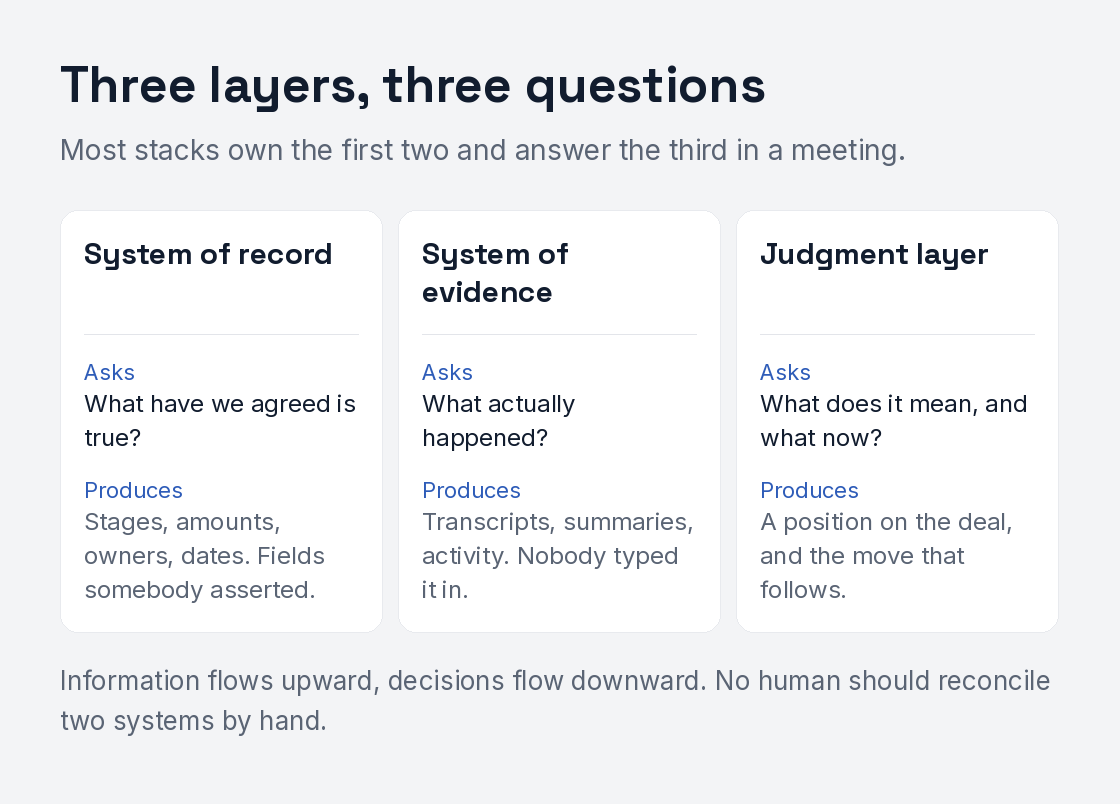
The system of record answers: what have we agreed is true? Accounts, owners, stages, amounts, close dates, what renews in March. A human or a process declares something, and the system stores that declaration and reports on it reliably.
The system of evidence answers: what actually happened? What was said, by whom, when. Nobody types it in. It exists because the conversation happened.
The judgment layer answers a third question: given all of that, what is true about this deal, and what should we do next?
The first two are well served and increasingly commoditised. Salesforce and HubSpot own the record. Gong and its category own the evidence, and Clari sits between the two, rolling structured signals into a forecast. The third question mostly gets answered in a meeting, by whoever is most senior and most confident, working from memory.
What a CRM is genuinely good at
Worth being fair here, because "the CRM is broken" is a lazy line and it is not true. A CRM does several things nothing else in the stack does well.
- Roll-up. Turning hundreds of opportunities into one number, sliced by segment, owner and period.
- Ownership and entitlement. Who owns the account, who is paid on it, who is allowed to see it. Unglamorous and legally necessary.
- Process enforcement. Required fields, approval flows, discount authority. If a quote must not leave the building without a signature, that rule lives in the CRM.
- Arithmetic. Win rates by segment, cycle length by source, coverage. Structured data is the only kind you can do sums on.
- Integration. Billing, marketing, support and provisioning all join on the CRM.
None of these belong anywhere else. Any vendor suggesting their tool replaces the CRM is describing a migration, not a product.
The limit is structural rather than a fault in the software. A record holds what somebody asserted. Gartner's State of Sales Operations research found that only 45 percent of sales leaders and sellers had high confidence in their organisation's forecasting accuracy, and only 47 percent believed their organisation held high-quality data. That is not an argument against CRMs. It is a description of what happens to any system that depends on people typing under time pressure.
What the evidence layer is genuinely good at
Conversation intelligence earns its place by capturing what a record cannot hold.
- Unstructured context, without labour. The objection raised once in month two. The reorganisation mentioned in passing. None of it fits a field, and all of it moves deals.
- Recall that outlives the rep. When someone resigns, the fields survive and the reasoning usually does not.
- Coaching material. Real examples of what was said, rather than a manager's reconstruction of it.
- A better-populated record. Next steps and summaries written from what was said rather than from what the rep remembers on a Friday afternoon.
This layer is valuable, and it is also where the market has spent most of its money and most of its attention over the past five years.
The question neither layer answers
Here is the test. Take the deal from the opening. The record says stage four. The evidence says four calls happened and an objection was raised in the second. Now ask the question a sales leader actually needs answered:
Is this deal going to close, what is stopping it, and what should the rep do on Monday?
Neither system answers that, and neither is built to. The record cannot, because every field in it is a claim somebody typed. The evidence layer cannot, because a transcript is a faithful account of a conversation and a deal is considerably more than its conversations. Deals move through internal meetings you are not in, procurement queues, security reviews, budget cycles and silence. Often the decisive fact is that nothing happened at all: the finance lead who never joined, the business case nobody circulated, the champion who replied within a day for two months and has now been quiet for eleven.
There is no recording of a meeting that did not take place.
The consequence shows up in how deals are lost. Analysis behind The JOLT Effect, drawn from more than two and a half million sales conversations, found that 40 to 60 percent of lost deals end in no decision, and that 56 percent of those losses were associated with customer indecision rather than a competitor. Those deals are not lost because nobody captured the calls. They are lost because nobody read the state of the deal early enough to act on it.
Gartner's May 2026 research points at the same missing layer from the other side. From a survey of 227 chief sales officers, organisations providing AI-enabled next best actions were 2.6 times more likely to achieve commercial growth. What moved the outcome was the guidance itself.
The four tests of a judgment layer
Plenty of products now describe themselves as deal intelligence, and most of them are an evidence layer with a score attached. Four questions separate the two, and they are worth asking in a demo.
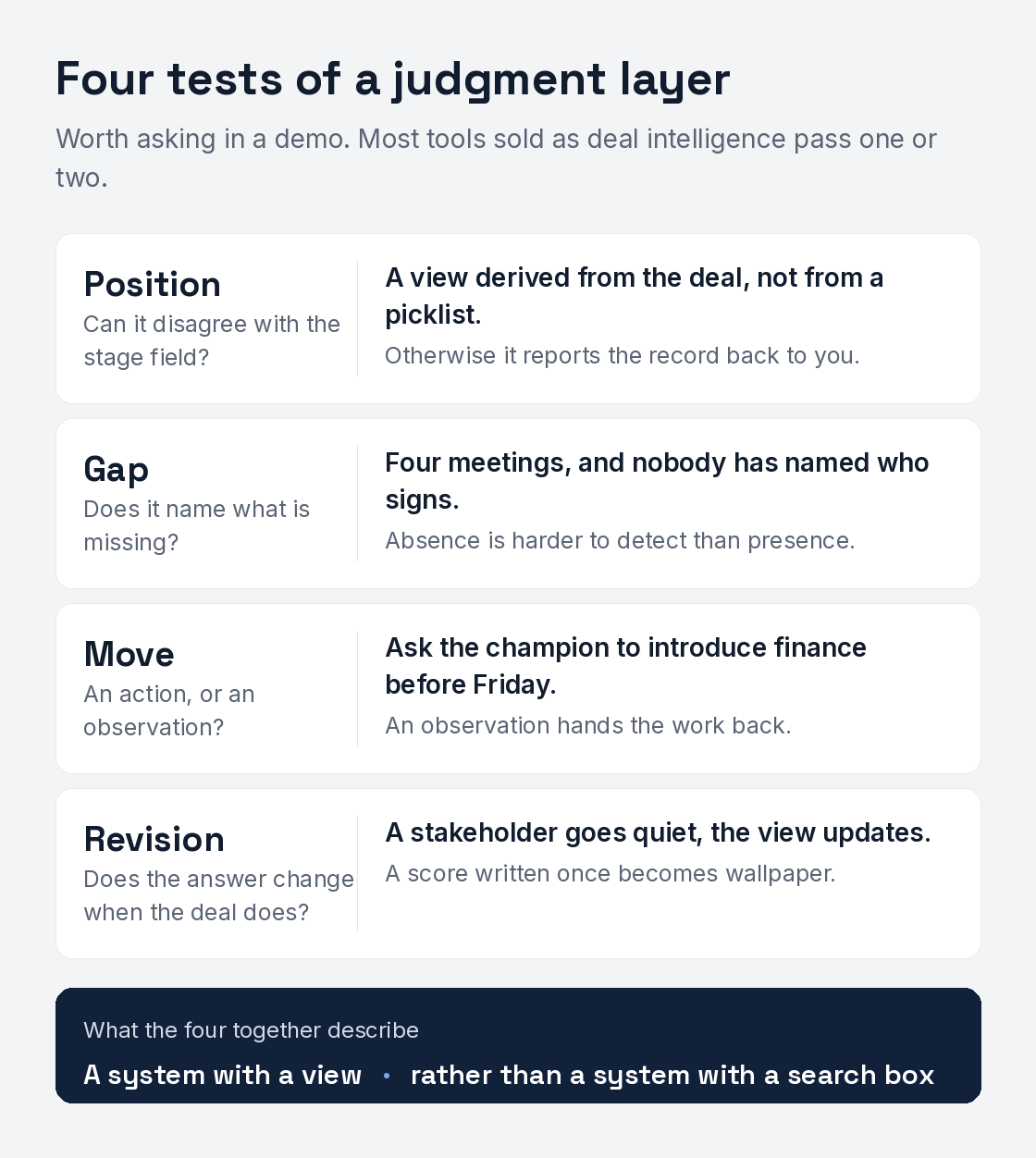
1. Position. Can it state where the deal stands on its own?
A judgment layer has to be able to disagree with the stage field and with the rep. If its view of the deal is derived from what somebody selected in a picklist, it is reporting the record back to you in a new colour. The real test is whether it can say that a deal marked commit is not supported by anything the buyer has done.
2. Gap. Does it name what is missing, not only what is present?
This is where most tools stop, because absence is much harder to detect than presence. A transcript search finds the mention of a budget. Nothing in a transcript tells you that in four meetings no one has ever named who signs. The gaps are the reason deals stall, and they are invisible to any system that only indexes what exists.
3. Move. Does it produce an action with an owner, or an observation?
"Champion engagement is declining" is an observation. "Ask the champion to introduce the finance lead before Friday, because they own the budget and have never been in a meeting" is a move. An observation transfers the work back to the person who was already stuck. Every gap that matters should turn into an action, an owner and a date.
4. Revision. When the deal changes, does the answer change?
A score generated once and left alone becomes wallpaper within a quarter. Deals change weekly. A judgment layer that does not revise its view when a stakeholder goes quiet or a date moves is a report, and reports get ignored in the order they were written.
Most tools sold under this heading pass one or two of these. The four together describe a system with a view, rather than a system with a search box.
Where the layers overlap
Five jobs sit where two layers could plausibly own them, and pretending otherwise is how teams pay twice for one capability.
| Job | Which layer should own it |
|---|---|
| Meeting notes and summaries | Evidence produces them, the record stores the approved version |
| Activity logging | Whichever system observes it first, writing into the record |
| Next steps and tasks | Judgment proposes, a human approves, the record holds it |
| Stage and close date | The record holds it, judgment is allowed to contest it |
| Forecast roll-up | The record, using inputs the other two layers made honest |
One rule resolves all five: information flows upward, decisions flow downward. Evidence feeds judgment, judgment writes back into the record, and no human should ever be asked to reconcile two systems by hand. Any workflow that requires a rep to copy something from one screen to another will be abandoned by month three.
What happens if you stop at two layers
Both partial stacks fail, and they fail differently.
Record only. Clean structure over thin content. The forecast rolls up beautifully from fields nobody can defend. When a strong performer resigns you keep the pipeline and lose the reason it exists.
Record plus evidence. This is the modern default and it is a real improvement, which is why the failure is harder to see. You get accurate capture, better notes, a CRM that is more true than it was, and coaching grounded in real calls. What you do not get is a view. The team has more information per deal than ever, spends its review meetings summarising that information to each other, and still leaves without knowing which three deals need intervention this week. The volume of available context grows every quarter and the number of people able to hold it in their head does not.
That second failure is the expensive one, because everything about it looks like progress.
Three questions before you add a third system
If the answer to all three is no, stay on two layers and spend the money elsewhere.
- Can you say what is stopping each of your top ten deals, right now, without asking the rep? If the honest answer is no, your forecast is a summary of recollections. That is survivable across ten deals and not across a hundred.
- When a deal review ends, does anything about the deal change? Count the actions with a named owner and a date that came out of last week's review. If the number is near zero, the meeting is producing analysis rather than movement.
- How much of your reviews goes to establishing the facts rather than deciding what to do? Measure one meeting. Most teams find the first half consumed by catching up, which is exactly the part a judgment layer removes.
There is a fourth consideration that is easy to miss. Complex purchases now involve buying groups that do not agree with each other. Gartner's 2025 survey of 632 B2B buyers found that 74 percent of buying teams showed unhealthy conflict during the decision, in groups running from five to sixteen people across as many as four functions. No amount of capture resolves that. Somebody has to form a view about which of those people matters and what would move them.
Where Vektor fits
Vektor is the judgment layer. It reads deal state from the CRM, emails, notes and documents a team already has, separates what is established from what is assumed and what is missing, and produces the next move on each deal with an owner attached. As the deal changes, the view and the recommended moves change with it.
It works alongside whatever record and evidence systems a team already runs, and it does not record calls.
Key takeaways
- A sales stack has three jobs, not two: hold what was agreed, capture what happened, and decide what to do. The first two are well served.
- A CRM is a system of record and its fields are claims. That is a property of records, not a defect in the software.
- Conversation intelligence captures what was said. Deals also move through silence, internal meetings and procurement, none of which produce a transcript.
- Judge a deal intelligence tool on four tests: can it take a position independent of the stage field, name what is missing, produce a move with an owner, and revise when the deal changes.
- Absence is the hard signal. Any system that only indexes what exists cannot see the gap that is killing the deal.
- Information flows upward and decisions flow downward. Nobody should reconcile two systems by hand.
- Record plus evidence is the most common stack and its failure looks like progress, because the information keeps improving while the decisions do not.
FAQ
What is deal intelligence? Deal intelligence is the layer of a sales stack that reads the state of an individual opportunity and determines what should happen next. It sits above the CRM, which records what was agreed, and above conversation intelligence, which captures what was said, and its output is a position on the deal plus a recommended action rather than stored information.
What is the difference between deal intelligence and conversation intelligence? Conversation intelligence records, transcribes and analyses sales calls, so its input is what was said in a meeting. Deal intelligence takes the whole deal as its subject, including emails, documents, buying process, stakeholder access and periods of silence, and its output is a judgment about the opportunity rather than an account of a conversation.
Does deal intelligence replace a CRM? No. The CRM remains the system of record for ownership, process, reporting and integration, and those jobs do not move. Deal intelligence reads from the record and writes proposed actions back into it, so the two are complementary layers rather than alternatives.
Do you need call recording for deal intelligence to work? No. Recordings are one useful input among several, and many teams of five to twenty-five sellers have no recording tool and no plan to add one. The evidence that a deal has stalled is often an absence, such as a stakeholder who stopped replying or a close date with no buying process behind it, and that is visible in the CRM, the calendar, the email thread and the documents.
How is deal intelligence different from a deal health score? A score compresses a deal into one number, usually derived from activity volume and stage. Deal intelligence has to name the specific thing that is missing and the action that would close it, and revise both as the deal changes. A number tells you to worry, and it does not tell you what to do on Monday.
Which layer should own next steps and tasks? The judgment layer should propose them, a person should approve them, and the record should store the approved version. Two systems holding competing task lists is worse than either one alone, and any workflow that asks a rep to copy tasks between systems will be abandoned within a quarter.
How can a sales leader tell whether a tool is a deal intelligence platform or a conversation intelligence tool with a score attached? Run the four tests in a demo. Ask it to show a deal where its view disagrees with the stage field, ask what is missing from a deal rather than what is present, ask what the rep should do next and check whether an owner and a date come with it, then change something about the deal and see whether the answer moves. A tool built on call analysis usually passes the third test and fails the second.
We already run a CRM and a call recorder, what does adding a third system actually change? It changes what happens between the capture and the decision. With two layers, a manager reads the record, reads the summaries, and forms the view themselves, which works until the number of deals exceeds what one person can hold. A judgment layer produces that view for every deal every week, so the review starts from a position and a set of gaps rather than from catching up.
How can enterprise sales management teams use AI to standardise deal inspection, coaching signals and seller judgment? Standardisation comes from applying the same checks to every deal, in the same order, regardless of who owns it. Agree what counts as evidence first, since two managers working from instinct will disagree about the same opportunity. Then the AI's job is to run those checks continuously and surface the gaps, which leaves the coaching conversation free for the part that needs a person.
What should a deal intelligence tool produce at the end of a week, in concrete terms? A position on each open deal, the specific evidence behind that position, the gaps that are keeping it from being stronger, and one or two actions per deal with a named owner. If the weekly output is a dashboard of scores with no actions attached, the tool has moved the analysis without moving the deals.
Sources
- Gartner, Gartner Says Less Than 50% of Sales Leaders and Sellers Have High Confidence in Forecasting Accuracy, from the State of Sales Operations Survey.
- Challenger, The JOLT Effect research on customer indecision, from analysis of over 2.5 million sales conversations.
- Gartner, Survey Finds Sales Organizations That Provide AI-Enabled Next Best Actions Are 2.6x More Likely to Achieve Commercial Growth, May 2026, survey of 227 chief sales officers.
- Gartner, Sales Survey Finds 74% of B2B Buyer Teams Demonstrate Unhealthy Conflict During The Decision Process, May 2025, survey of 632 B2B buyers.
Related: Deal inspection: how to know if a sales deal is actually moving · How to write a business case your champion can defend · The 9 best AI deal coaching tools in 2026