A business case is the document that answers what a decision costs, what it returns, and how certain anyone is of either. In a B2B deal it has one job: to hold up in a meeting you are not invited to, presented by someone who does not work for you.
Most business cases are built to persuade instead. They lead with the largest defensible number, smooth over the assumptions, and read like something written by the party who benefits. Your champion then carries that document into a room where a finance lead reads it with one question in mind: what happens to me if this number is wrong?
The research is clear about which failure actually kills deals. Analysis of more than two and a half million sales conversations behind The JOLT Effect found that 40 to 60 percent of lost deals end in no decision at all. Of those, 56 percent were lost to indecision, meaning fear of getting it wrong, rather than to a preference for the status quo. Some level of indecision showed up in 87 percent of all deals studied.
So the most common way to lose is to a buying group that could not get comfortable enough to act. A bigger number does nothing about that. A number nobody can attack does.
Why the persuasive business case is losing ground
Two things have changed underneath this document in the last two years.
The first is verification. According to the TrustRadius 2026 B2B Buying Disconnect Report, 94 percent of B2B buyers now fact-check AI research outputs, and the share of buyers saying they trust online resources less than they used to rose from 39 percent to 47 percent in a year. Your case gets checked, often against a model that will happily point out that your benchmark is a decade old.
The second is what happens after the purchase. The same report found that tools without documented ROI are the first to be cut when budgets tighten, however useful people find them. Your champion knows this. They are deciding whether they want their name on a number they will be asked about in twelve months.
One finding pulls the other way, and it is the reason this document still matters. Gartner's May 2026 survey of 645 B2B buyers found 69 percent prefer to validate AI-generated insights with a sales rep, and that reps remain the most important information source at three moments: researching the problem, securing internal support, and finalising the purchase. Securing internal support is your champion's job, and being useful at that moment is yours.
Stop building a different version for each stakeholder
Every instinct says personalise. Build the CFO version, the IT version, the ops version.
Gartner's survey of 632 B2B buyers found that content tailored for relevance to the buying group improved consensus by 20 percent, while content tailored for relevance to the individual had a 59 percent negative impact on consensus. Buyers who experienced group-level relevance were three times more likely to report a high-quality deal. Groups that reached consensus were two and a half times more likely to say the same.
The cause is confirmation bias. Give each stakeholder a version that reinforces what they already believe and you harden their separate positions, so when they meet they are defending three cases instead of comparing one. That study also found 74 percent of buyer teams already show what Gartner calls unhealthy conflict, in groups running from five to sixteen people across as many as four functions.
One document, one set of numbers, legible to everyone in the room. Tailoring belongs in which sections you point a stakeholder at, not in giving them different arithmetic.
The four parts every number needs
This applies to each figure in the case rather than to the case as a whole. Every number carries four parts.
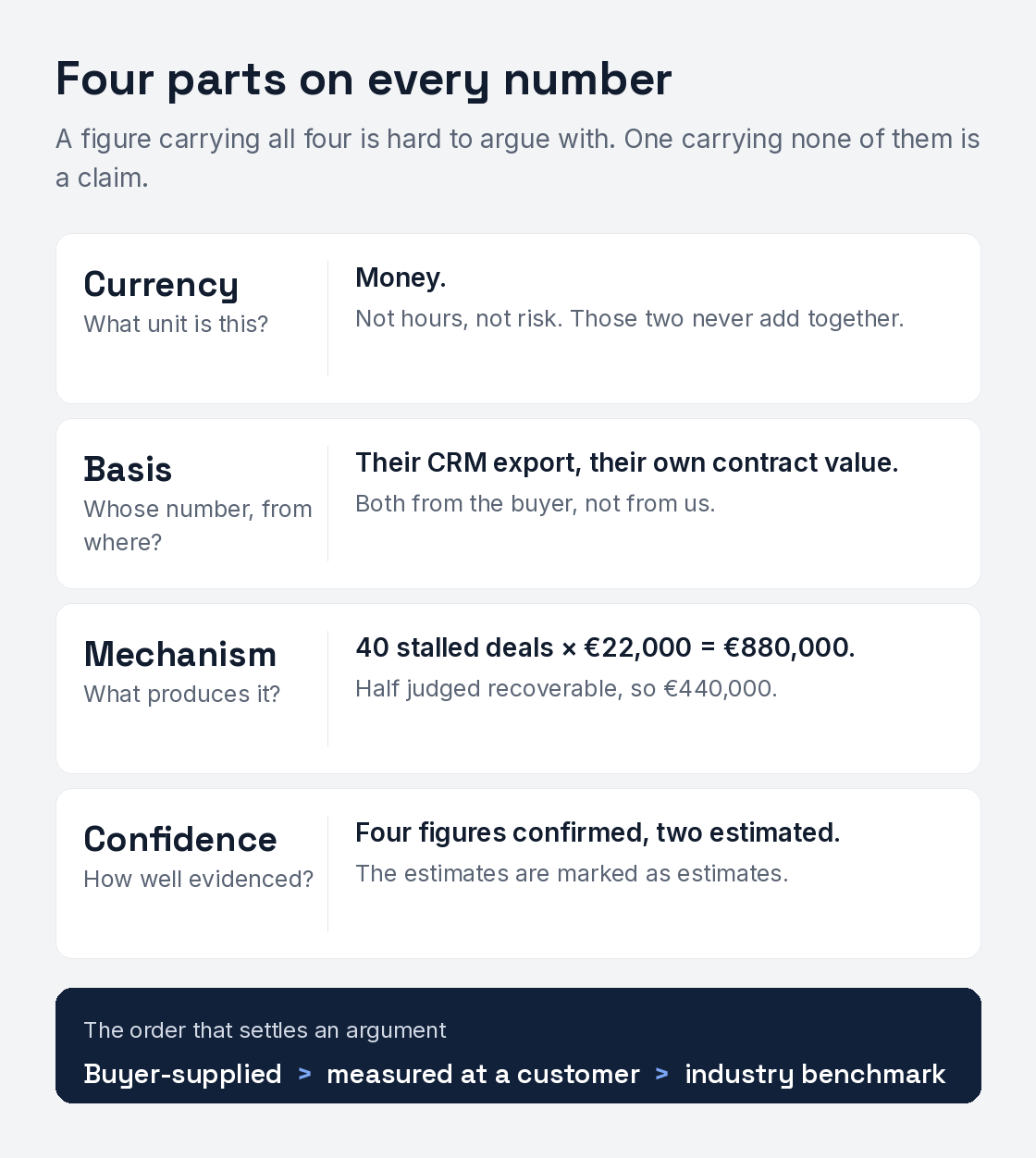
A figure carrying all four has already answered the questions a finance reviewer would ask. A figure carrying none of them is a claim, and claims get discounted to zero by people who read a lot of vendor documents.
Currency: name the unit before you do any maths
Most business cases quietly convert everything into money, because money is the language of approval. That conversion is where credibility leaks.
There are four currencies in a typical case. Money is cash saved or earned. Hours are time returned to people. Capacity is work the organisation can now do that it could not do before. Risk is exposure reduced, which is a probability multiplied by a consequence rather than a quantity.
Two rules follow.
Hours are not money until someone says what happens to the hours. Sixty hours a month returned to a team is worth nothing on a P&L unless those hours go to something that generates revenue, or unless headcount actually comes out. When your case multiplies hours by a loaded hourly rate and calls the product savings, a finance reviewer reads that as a seller who has not understood their business. Present the hours as hours and let the buyer tell you what they are worth.
Risk and money do not add. A case that sums 200,000 in efficiency gain with 500,000 of avoided regulatory exposure and prints a 700,000 headline is incoherent, because one figure is expected and the other is contingent. Keep separate currencies in separate lines with separate totals. Three honest subtotals beat one headline the reviewer cannot accept, because they can agree with one argument while rejecting another instead of rejecting the document.
Naming the currency also answers what your champion is being asked upstairs, which is what kind of argument this is. Money, time, capacity and risk each go to a different approver and survive a different kind of scrutiny.
Basis: whose number, from where
Every figure comes from somewhere, and the somewhere matters more than the figure.
"Teams like yours typically see a 30 percent improvement" has no basis. Nobody said it, nothing measured it, and the reviewer cannot check it. It drags down everything printed near it.
"Your ops lead put the current cycle at eleven days on the 14 August call" names the person, the number and the date, so it can be checked. A checkable number that turns out to be slightly wrong costs you a correction and nothing else.
Write the basis into the line itself rather than into a footnote. The reviewer should never have to ask where a number came from, because asking is the moment the case stops being read and starts being interrogated.
Mechanism: show the arithmetic
Mechanism is the part most business cases skip, and the part that turns a set of numbers into an argument.
List a current-state figure, an improvement rate and an annual value, and the reviewer has three numbers with no way to see how the first became the third. Their only options are to accept it or reject it, and neither is a conversation.
Compare:
| Line | Figure | Where it came from |
|---|---|---|
| Current cycle time | 11 days | Your ops lead, 14 Aug call |
| Reduction at a comparable deployment | 4 days | Measured at a customer |
| Deals per quarter affected | 40 | Your CRM export, 2 Aug |
Mechanism: 4 days saved on 40 deals per quarter returns 160 deal-days per quarter, roughly 640 a year.
Now the reviewer can argue with the parts. Maybe they think 40 is really 30. They can recalculate without you, which was the entire objective, and the corrected version is one they had a hand in.
This is also the practical answer to the fear-of-being-wrong problem. Nobody is scared of a number they can re-derive.
Confidence: label the strength of every figure
The instinct is to present every number with equal certainty, since flagging a weak one seems to invite attack. If nothing is labelled, the reviewer assumes the weakest standard applies throughout, and the strong numbers get dragged down to the level of the weak ones.
Three labels are enough:
Buyer-supplied. Their number, from their mouth or their system. The strongest thing in the document.
Measured at a customer. An actual outcome at a named or described comparable organisation. Strong, and it must carry the attribution.
Industry benchmark. Published research or a category average. Useful for framing scale, weak for justifying spend, and it should never carry the headline.
The order is a precedence rule. The buyer's own numbers outrank an outcome measured elsewhere, which outranks a benchmark. Put the labels on the page and that hierarchy stops being something you have to argue for.
There is deliberately no label for "our estimate". If a figure has no basis outside your own modelling, it is not evidence, so either get it from the buyer or leave it out.
The cost of inaction is a business case in its own right
Most sellers treat cost of inaction as a section inside the gain case. It can be the whole case, and often it is the better one.
Which one leads depends on what the buyer is actually afraid of. A gain case asks them to believe in an upside that has not happened yet, which for a nervous buying group is one more thing to be wrong about. A cost-of-inaction case prices the risk they are already carrying, and carrying it is the option that currently feels safe. Given that 56 percent of no-decision losses trace to fear of getting it wrong rather than to contentment with the status quo, that reframe does more work than a larger ROI figure.
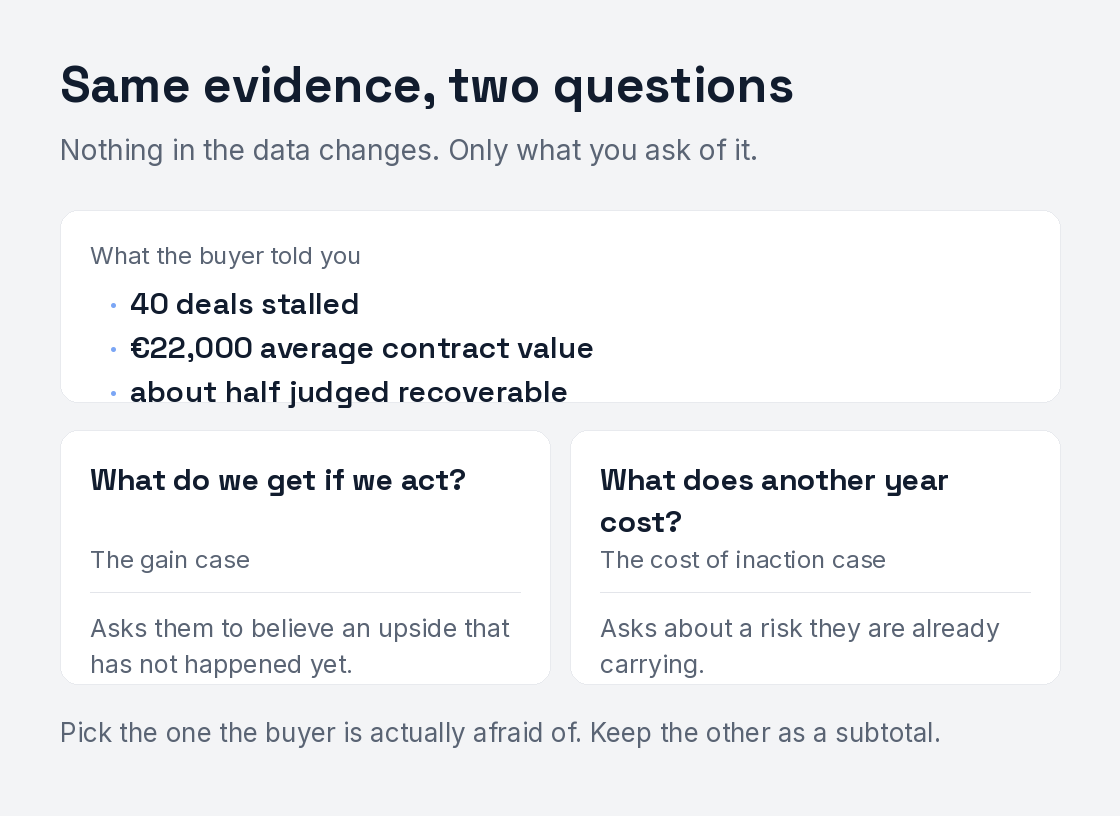
This is a choice of frame rather than a second calculation. The buyer's facts are the same in both, and each figure still needs its four parts. What the worked version looks like is further down.
Three things to get right if you run it as the leading case.
The four parts still apply, and confidence matters more here, not less. A cost-of-inaction case assembled from your own assumptions is a scare story, and reviewers recognise one immediately. This is the case that most needs buyer-supplied figures.
Risk is a currency with two components. A probability and a consequence. Quote both and keep them visible, because a reviewer who cannot see the probability will assume you picked the consequence and hoped. "Roughly one in three of these stall past the quarter, and each one is worth 22,000" survives scrutiny in a way that "880,000 at risk" does not.
Do not run both cases at full volume in one document. Pick the leading case and keep the other as a subtotal. Two headline numbers in two directions reads as a seller covering every angle, and the reviewer has to work out which one you actually believe.
If the buyer built the cost-of-inaction number with you during discovery, you already have this, carried forward with its currency, basis, mechanism and confidence intact.
What to do with the numbers you do not have
Most cases are built with gaps. The usual responses are to leave the gap out and present a thinner case as complete, or to fill it with a benchmark and hope nobody checks.
There is a better third option. Name the gap, name who can close it, and name what closing it unlocks.
- Not yet known. What a lost deal costs you at current ACV.
- Who closes it. Maria has the number in the Q2 board pack.
- What it unlocks. Converts the win-rate argument from directional to quantified.
Three things happen. Your champion gets a specific, low-effort task instead of a vague sense that the case is incomplete. The reviewer sees a seller who separates what is known from what is assumed, which raises the credibility of everything that is known. And you have a reason for the next conversation that is useful to the buyer.
Written in the negative, the same content reads as failure: "cannot calculate without further information". Written as an action with a named owner and a stated payoff, it reads as a plan.
What this looks like assembled
Here is the same case as a working document. Each line carries its figure, and each figure carries how well evidenced it is, so the bottom line inherits the weakest thing it depends on rather than presenting itself as solid.
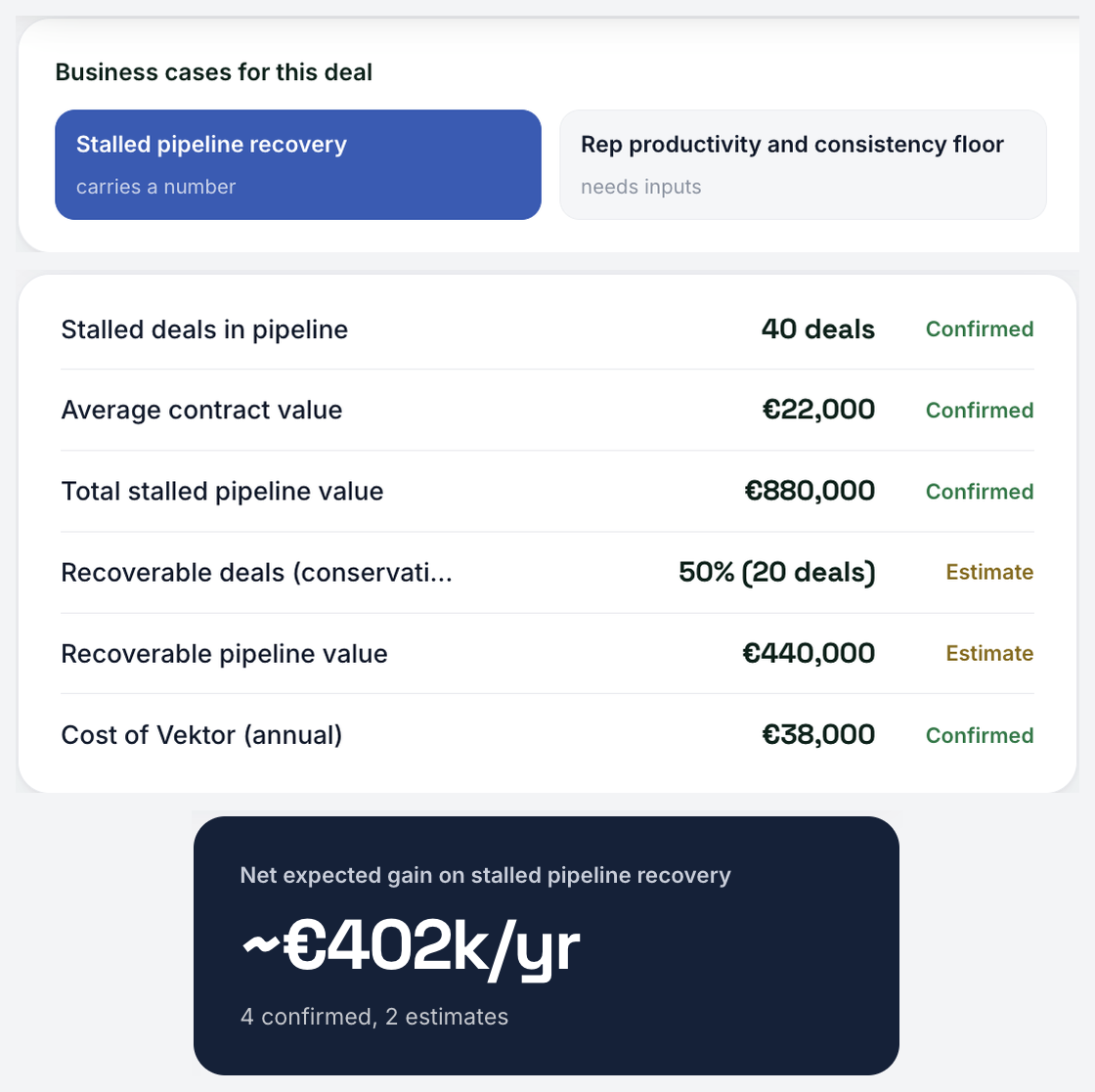
Two details worth copying whatever you build this in. The estimated rows are marked as estimates on the same line as the figure, so nobody has to hunt for a footnote. And the headline says what it is made of, four confirmed figures and two estimates, which tells a reviewer how hard to push before they start pushing.
The document itself
A reviewer's time is short and the order is not arbitrary.
The problem, in their terms and at their altitude. Not "reps spend too long preparing". Instead, the constraint on an outcome the executive already owns, stated with their metric. If the problem statement does not connect to something already on the leadership agenda, the rest of the document is optional reading.
The cost of continuing as is. Covered above, and the most skipped section. Without it your price is compared against zero, and zero always wins.
What you are proposing, in one paragraph. No feature list. If your champion needs more than a paragraph to explain what this is, the case will not survive being retold.
Total cost, not licence cost. Licence, implementation, training, integration effort, internal time. Reviewers have been burned by hidden costs before and will assume the number is incomplete unless you visibly complete it. Understating total cost loses the room fastest, because it is the one thing they can verify without you.
Proof from a comparable organisation. One story, two sentences, similar size and motion. Not a logo wall, and not a category-wide average. If your closest comparable is imperfect, say so and say what makes it comparable anyway.
The ask, with a date. A specific decision, a specific approver, a specific date, and what happens next if the answer is yes. Your champion will use this wording verbatim, so write it as though they will.
Format, briefly
One page for a document sent ahead of a meeting. Six slides maximum if your champion is presenting, problem first, so that if you lose the room it happens after they have understood the problem.
For the verbal version, two minutes: problem, cost of continuing, what it is in one sentence, the headline number with its currency and basis, the ask. Your champion should manage that without notes, because there will be a corridor conversation you never hear about and it will matter.
Gartner's buyer enablement research found buyers who use supplier-provided tools to complete their buying jobs are 1.8 times more likely to land a high-quality, low-regret deal than buyers working alone. This document is the part of your product the buyer uses before they buy anything.
When your champion says they do not need it
Some champions push back. They will handle the internal conversation, just send pricing.
Take it seriously rather than overriding it, because it usually signals one of two things. Either they are confident in their internal influence, which may or may not be well calibrated, or they are protecting internal relationships from a formal process, which tells you the politics are more complex than they have described. Both are worth knowing.
What works is lowering the effort rather than insisting: "Happy to keep it informal. Would a one-pager with the key numbers be more useful, or a summary email you can forward as is?"
Something written, with the numbers and their basis, that travels without you. The format is negotiable. Having something is not, because the meeting where the decision gets made is one you will not attend. On telling apart a champion who can carry this from a contact who likes you, see how to qualify a deal when the buyer is telling you what you want to hear.
Where Vektor fits
Vektor builds the business case from the evidence already on the deal, and structures each figure the way this article describes: its currency, its basis, the mechanism behind it, and how well evidenced it is. Where a number is missing it names who to ask and what that number would unlock rather than filling the gap with a benchmark. The point is that the arithmetic stays visible, so the case can be argued with by people you will never meet.
Key takeaways
- Deals are lost more often to a buying group too uncertain to act than to a competitor. Build the case to survive interrogation.
- Every number needs four parts: currency, basis, mechanism, confidence.
- Keep currencies separate. Hours are not money until the buyer says what happens to the hours, and risk never adds to money.
- Write the arithmetic down. A reviewer who can recalculate your number without you can defend it without you.
- Label the strength of each figure. Buyer-supplied outranks measured at a customer, which outranks industry benchmark.
- The cost of inaction can carry the whole case. Pick a leading case and keep the other as a subtotal.
- Name the gaps as actions with an owner and a payoff.
- One document for the whole buying group. Per-stakeholder versions break consensus.
FAQ
What is a business case in sales? A business case is a short document setting out what a proposed purchase costs, what it returns, and how well evidenced each of those figures is. In a B2B deal its real purpose is to let an internal champion make the argument to their own stakeholders when the seller is not present.
Who should write the business case, the seller or the champion? The seller supplies the components and the arithmetic, the champion owns the final version. A document that reads as though it came from the vendor loses credibility inside the buying organisation, so expect your champion to rewrite the framing. What must survive their edit is the basis and mechanism behind each number.
How long should a business case be? One page for a pre-read, six slides maximum if it is presented. If it needs more than that to convince, the underlying value argument is not clear enough yet, and adding pages will not fix it.
Should the business case lead with ROI or with the cost of inaction? Lead with whichever the buyer is more afraid of. A gain case asks them to believe in an upside that has not happened; a cost-of-inaction case prices the risk they are already carrying. With most no-decision losses driven by fear of getting it wrong, the cost of inaction is often the stronger lead. Keep the other as a subtotal rather than running both as headlines.
What if I have no customer ROI data yet? Use the buyer's own numbers. Buyer-supplied figures outrank anything from your reference library, so a case built entirely from their data and labelled as such is stronger than one leaning on benchmarks. Where a figure is genuinely unavailable, name it as a gap with an owner rather than substituting an industry average.
Why do business cases fail internally? The figures are too vague to defend, so the reviewer discounts them. Or the cost of continuing as is has not been quantified, so the investment is compared against zero. Or the ask is unclear, so nobody knows what saying yes commits them to.
Should I make a different version for each stakeholder? No. Gartner's research found content tailored to individual stakeholders had a 59 percent negative impact on buying group consensus, while tailoring to the group improved it by 20 percent. Use one document with one set of numbers, and direct different stakeholders to different sections of it.
How can a seller build a business case the champion can defend in a meeting the seller is not invited to? Make the champion the author of the numbers rather than the recipient of them. Every figure needs its currency, its basis, its mechanism and a stated confidence level, and the basis should be something the buyer supplied or confirmed. A champion defending their own arithmetic survives questions that a champion reading your slide does not.
Which numbers in a business case survive scrutiny from a finance team, and which get discounted? Numbers the buyer supplied survive best, followed by figures measured at a comparable customer, followed by industry benchmarks, which finance teams discount heavily and sometimes ignore. What gets a case dismissed fastest is a large saving with no stated mechanism, because the reader cannot check it and therefore assumes it is decoration.
We have no customer ROI data yet, how can we build a credible business case anyway? Build it entirely from the buyer's own figures and state your confidence honestly. Ask what the process costs them today, what volume runs through it, and what a percentage point of improvement would be worth, then label those as buyer-supplied estimates. A modest case the buyer built is more defensible than a large one you sourced from a benchmark report.
How can a sales team standardise business cases across reps without making them generic? Standardise the structure rather than the content. Requiring currency, basis, mechanism and confidence on every number forces the same rigour on every deal while leaving the actual figures specific to that buyer. What produces generic cases is standardising the numbers themselves, usually through a template with defaults nobody removes.
Sources
- Challenger, The JOLT Effect research on customer indecision, based on analysis of over 2.5 million sales conversations.
- Gartner, Survey Finds 69% of B2B Buyers Turn to Sales Reps to Validate AI-Generated Insights, May 2026, survey of 645 B2B buyers.
- Gartner, Sales Survey Finds 74% of B2B Buyer Teams Demonstrate Unhealthy Conflict During The Decision Process, May 2025, survey of 632 B2B buyers.
- TrustRadius, 2026 B2B Buying Disconnect Report.
Related: How to run discovery that pays off at every stage of the deal · How to qualify a deal when the buyer is telling you what you want to hear · The pattern interrupt