Monday morning, forty minutes, eleven open deals. The rep talks through each one in the order the CRM happens to list them. The manager asks good questions on the first three, runs short of time on the next five, and skims the last three because they are small. Somewhere in the middle, a deal that has not moved since August gets four minutes and a nod. At the end everyone has a clearer picture of the pipeline than they had at the start, and the meeting ends because the next one is starting.
The following Monday the same eleven deals come up in the same order, and nobody can remember what was decided about any of them.
The fix for that is not a better agenda or a different cadence. A pipeline review can run perfectly well as a meeting and still produce nothing except a shared understanding of what everybody already suspected.
What a pipeline review is actually for
Three things get run together under one name, and separating them makes each one easier to do.
Forecasting asks what will close and when, and it rolls up across the team.
Deal inspection goes down into one opportunity and tests whether the evidence supports the story being told about it.
A pipeline review sits between the two. It works across a rep's book, decides where the week's effort goes, and commits to specific changes on specific deals. Of the three it is the only one whose job is to change what somebody does on Tuesday.
Plenty of reviews end without a single decision in them. The deal gets discussed, the risk gets acknowledged and the meeting moves on. Gartner's State of Sales Operations Survey found that fewer than half of sales leaders and sellers had high confidence in their organisation's forecasting accuracy, and the weekly review is the main place that confidence is supposed to come from.
What goes wrong in the review
Four things, in roughly the order they do damage.
The review runs on recall
The manager's information about the deal arrives through the person who has spent six weeks inside it. That is a feature of the format rather than a failing of the rep. After enough conversations the things a buyer implied start to sound like things a buyer said. "They are aligned on the business case" can mean the buyer confirmed the numbers in writing, or it can mean the call went well and nobody objected. Both sound identical out loud, and the review has no way to tell them apart.
Attention gets allocated by list order
Most reviews walk the pipeline top to bottom, or by close date, or by value. None of those orders match where the risk is. A large deal that is genuinely progressing takes twenty minutes because it is important, while a mid-sized deal where the champion stopped replying nine days ago gets two, because nothing about it looks dramatic in a list.
The output is an intention
"I will chase the champion." "Let me get procurement moving." "I will push for a meeting with the CFO." None of those say what the buyer will do, what would show it happened, or when anyone checks. A week later the rep has genuinely chased the champion and the deal is exactly where it was.
Nothing carries forward
The commitment made on Monday lives in a notebook, a Slack thread or somebody's memory. The CRM never hears about it. So the following Monday the review cannot open with the question that matters most, which is what happened to last week's decisions.
A review that cannot remember what it decided last week is a status meeting with a better name.
What the tools do not capture
The technology around a pipeline review is genuinely good, and each part of it is good at something different.
Salesforce and HubSpot hold the record: stage, amount, close date, owner, next step. Every one of those fields is a declaration that somebody made and the system stored faithfully. A close date stays an intention until a buying process stands behind it.
Gong and the conversation intelligence category hold the evidence of what was said, in transcripts, summaries and flagged objections. That is real evidence and it beats recall comfortably, for the portion of the deal that happens on a call.
Clari and the forecasting layer roll structured signals into a number and show how the number is trending.
Between them they cover a great deal, and three things still fall through.
Absence. Deals stall quietly. The champion who used to reply within a day now has an email that is eleven days old. The finance lead who was going to join the next call never did. The business case the buyer promised to circulate has not come up since. None of that is an event, so nothing generates a record of it, and a recording cannot describe a meeting that never took place.
Everything that is not a call. Deals move through email threads, procurement queues, security reviews, legal, and the buyer's own internal discussions that no vendor attends. Gartner's May 2025 survey of 632 B2B buyers found that 74% of buying teams showed unhealthy conflict during the decision process. That conflict plays out where no seller is present, and it decides the deal.
The commitment the review itself produced. A pipeline review generates decisions every week, and no system in the stack stores them as anything a machine could later check. The action lives as text in a note, when it is written down at all. Nothing can tell you on Thursday that Monday's action has not happened, because nothing knows it was ever promised.
That third one sits between products rather than inside any of them. The record system holds what was declared and the evidence system holds what was said, while the decision taken about the deal lands in neither.
The four things each deal should produce
A review works when every deal that gets discussed leaves with four things settled, which is realistic for four or five deals in a weekly slot and unrealistic for eleven.
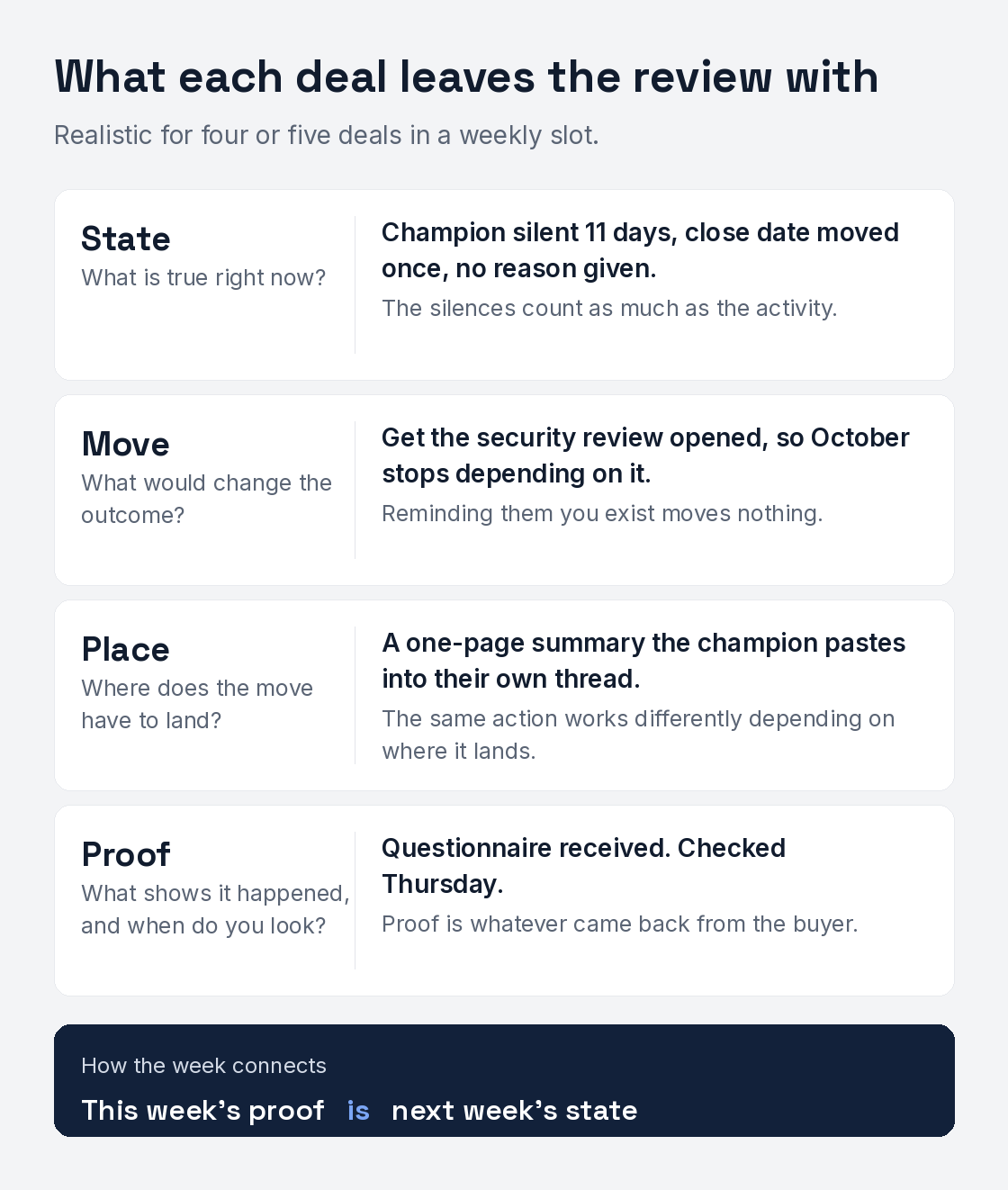
1. State. What is true about this deal right now?
The stage field and the rep's read are both downstream of this. What matters is what the buyer has done, what they have stopped doing, and how long it has been. A useful state describes the silences as well as the activity: who has gone quiet, which promised action never arrived, which date moved without an explanation.
- "What has the buyer done since we last spoke about this, that came from them?"
- "Who was active a month ago and is not active now?"
- "What is the close date standing on, and who told us that?"
- "What did they say they would do internally, and has anyone seen it?"
2. Move. What would change the outcome?
Reviews tend to skip this. A gap gets named and the response is whatever is most obvious, which is usually to chase, follow up or send something. The obvious response is often the right one, and it is worth thirty seconds to establish that rather than assume it.
A move earns its place when it changes what the buyer is able to do. Getting a security questionnaire started in week three changes the close date that is actually achievable. A fourth follow-up email changes nothing about the deal, whatever it does for the activity count.
Gartner's May 2026 research found that sales organisations providing AI-enabled next best actions were 2.6 times more likely to achieve commercial growth, from a survey of 227 chief sales officers. The same release, drawing on 645 B2B buyers, found that buying groups with low dysfunction were 13 times more likely to report a high-quality deal. Good guidance matters, and so does whether that guidance is aimed at the buying group or at one person inside it.
- "If this deal is lost in six weeks, what will the reason have been?"
- "What would have to become true for that reason to disappear?"
- "Does this action change what they can do, or does it only remind them we are here?"
3. Place. Where does the move have to land?
This gets discussed least often and it frequently decides whether the action works at all, because the same action succeeds or fails depending on where it happens.
A reply in an existing thread reaches one person who is already engaged. A new meeting costs the buyer something and therefore tests how serious they are. A one-page summary the champion can paste into their own internal thread reaches the people who are arguing about this where you have no visibility. A question routed through procurement comes back with a date attached, because dates are what procurement deals in.
The same Gartner survey of 632 buyers is useful here: tailoring information to individual buyers had a 59% negative impact on the group reaching consensus, while tailoring to the group as a whole had a 20% positive impact. Where the move lands changes what the move does.
- "Who needs to see this, and are they in our thread or in theirs?"
- "Does this need to survive being forwarded when we are not there to explain it?"
- "Is there a process here with its own queue and its own clock, and are we in it?"
4. Proof. What shows it happened?
An action needs an owner, which most teams already manage, and it needs a named artifact, which almost nobody does.
The artifact is whatever you can point at next week: a calendar invite that came from their side, a reply from the CFO's assistant, the security questionnaire landing in the inbox, the champion using the business case numbers in their own words. Sending an email is not proof of anything, because sending is something the rep did. Proof is what came back.
Then it needs a date, meaning the day somebody actually looks for the artifact rather than the day the deal is meant to close. If the action is to get the security review started and the artifact is the questionnaire arriving, the check is Thursday.
Weaker. "Rep to follow up with champion this week."
Stronger. "Champion to confirm the security review start date in writing. Check Thursday. If nothing has come back by Thursday, the champion is not carrying this internally and we stop treating the October date as supported."
The second one closes itself. Thursday arrives and either the artifact is there or the deal has told you something.
The next review opens with the proofs
One habit carries most of this, and it costs five minutes.
Every pipeline review starts with the actions from last time and what the proof says about each one, before any new deal gets discussed. Three outcomes are possible and they mean different things.
The artifact arrived, so the deal moved, and the state you open with this week is better than last week's.
The artifact did not arrive and the rep did not do the action. That is a workload conversation and it is usually a fair one, since eleven deals in forty minutes tends to generate more actions than any week can absorb.
The artifact did not arrive and the rep did do the action. This is the case worth having, and most reviews never surface it because nobody went back to check. The rep asked and the buyer did not respond. Nothing slipped internally, and the silence itself is information about the deal, frequently the earliest reliable signal that it is going nowhere. Analysis behind The JOLT Effect, drawn from more than 2.5 million sales conversations, found that 40 to 60% of lost deals end in no decision, with 56% of those associated with customer indecision rather than a competitor. Indecision tends to announce itself in exactly this way: a reasonable request, met with nothing.
Opening on proofs also changes how the meeting feels. An unmet commitment becomes a fact about the buyer that everyone can look at together, instead of an awkward moment for the rep.
A workable forty minutes
- Five minutes. Last week's actions and their proofs, before any new deal comes up.
- Twenty-five minutes. Four or five deals chosen by risk: anything in commit, anything large enough to change the quarter, and anything whose state has changed or has conspicuously stopped changing. Each one leaves with state, move, place and proof.
- Five minutes. Deals nobody has mentioned in three weeks, read out by name without discussion. This is where quiet stalls surface.
- Five minutes. What the rep needs from the manager, which is usually an introduction, a pricing decision or a second person on a call.
Deals outside that list are not being ignored. They are waiting for a change worth discussing, and the point of reading out the quiet ones is to catch anything that has been waiting too long.
Where Vektor fits
Vektor reads the state of each open deal from the evidence already sitting in the CRM, the email thread and the calendar, including the absences: who has gone quiet, which promised step never arrived, which date has nothing behind it. It puts that state and a recommended action in front of a manager before the review starts, so the meeting can open on decisions instead of recap.
Each recommended action carries an owner and what should come back from the buyer, and the deal's state updates as they respond or fail to. The following week's view reflects what happened to last week's action.
No call recording is required. Teams of five to twenty-five sellers often have no conversation intelligence in place, and the evidence that a deal has stalled is usually an absence, which would not appear in a transcript in any case.
Key takeaways
- A pipeline review exists to produce decisions. A forecast call produces a number and an inspection produces the truth about one deal.
- Reviews run on recall, and recall cannot separate what a buyer confirmed from what a buyer simply did not object to.
- Walking the pipeline in list order spends the most attention on the deals that are easiest to talk about.
- The CRM holds declarations and conversation intelligence holds what was said on calls. Neither holds the absence of activity, or the commitment the review itself made.
- Each deal discussed should leave with four things settled: state, move, place and proof.
- Where an action lands matters as much as what it is, because information aimed at one person works differently from information aimed at the buying group.
- Proof is what came back from the buyer, which is a different thing from what the rep sent.
- Open every review on last week's proofs. An action the rep completed that produced no response is information about the deal rather than a task that slipped.
FAQ
How long should a pipeline review meeting be and how often should it run? Weekly and around forty minutes works for most teams carrying ten to thirty open deals per rep. The constraint that matters is how many deals you attempt rather than how long you sit there. Four or five deals handled properly change more than eleven deals summarised. Fortnightly can work for longer sales cycles, though the gap weakens the follow-up check, because two weeks of silence from a buyer is harder to act on than one.
What is the difference between a pipeline review, a deal inspection and a forecast call? A forecast call asks what will close and when, and it rolls up across the team. A deal inspection goes down into a single opportunity and tests whether the evidence supports the story being told about it. A pipeline review works across one rep's book and decides where the week's effort goes. Of the three, the review is the one whose output is supposed to be a set of actions.
Our reviews always produce action items and they still do not get done, what is missing? Usually two things. The action describes what the rep will do rather than what the buyer will do, so it can be completed in full without anything changing on the deal. And nobody named an artifact or a date to check, so there is no moment where the action is either done or not. Adding a named artifact that has to come from the buyer, plus a check date a few days out, fixes most of it.
How can a sales manager tell whether a deal is stalling before the close date slips? Look for absence rather than for events. No buyer-initiated action in two or three weeks, a stakeholder who was engaged a month ago and has gone quiet, a close date that moved with no explanation behind it, a promised internal introduction that never happened. These are usually visible weeks before the deal is formally lost, and none of them generate a notification in a CRM.
We already run pipeline reviews from a CRM dashboard, what would we gain from anything else? A dashboard reports the fields somebody entered. It will show you a deal sitting in stage four with a close date of 30 September, and it will show that with equal confidence whether or not the buyer has done anything for three weeks. What it will not surface is the absence of activity, the commitment made in last week's review, or the relationship between the two.
I want software that tells my managers which deals to focus on in the weekly review rather than making them read every opportunity, what options exist? Several categories approach this from different directions. Forecasting tools such as Clari rank by deal value and probability. Conversation intelligence tools such as Gong surface risk from what was said on recorded calls. Deal intelligence tools, Vektor among them, read the state of each deal from CRM, email and calendar activity and rank by what has changed or stopped changing. The right choice depends mostly on whether your team records calls, and on whether your risk tends to show up in conversations or in silence.
How can a sales team running no conversation intelligence still run a rigorous pipeline review? Comfortably, because most of the evidence a review needs was never in a transcript. Who replied and how quickly, who stopped replying, which meetings the buyer booked, which documents came back, what procurement has acknowledged: all of that already sits in the CRM, the calendar and the email thread. The clearest signal that a deal has stalled is an absence, and absences never appear in a recording.
How should a manager handle a rep whose deals keep stalling without the review turning into an interrogation? Keep every question on the deal rather than on the person. Asking what would create a route to the budget holder produces a different conversation from asking why there is no route yet. That matters practically as well as socially, because defensive answers are worse evidence than no answer at all. Opening on proofs helps here too, since an unmet commitment becomes a fact about the buyer rather than a verdict on the rep.
Which deals should be discussed in the review when a rep has thirty open opportunities? Anything in commit, anything large enough that losing it changes the quarter, anything the rep has flagged, and anything whose state has changed or has conspicuously not changed. Then spend the last few minutes reading out the names of deals nobody has mentioned in three weeks, without discussing them. Quarter-end surprises come from that group, and those deals never nominate themselves.
What should the manager do when an action was completed and the buyer still did not respond? Treat it as a finding. A reasonable request met with silence is one of the earliest reliable signals that a deal is going nowhere, and it is more informative than most of what gets said on a call. The usual next step is to test the same question through a different person, a different route or a different part of the buying process, and to stop treating the current close date as supported until something comes back.
Sources
- Gartner, Gartner Says Less Than 50% of Sales Leaders and Sellers Have High Confidence in Forecasting Accuracy, from the State of Sales Operations Survey.
- Challenger, The JOLT Effect research on customer indecision, from analysis of over 2.5 million sales conversations.
- Gartner, Survey Finds Sales Organizations That Provide AI-Enabled Next Best Actions Are 2.6x More Likely to Achieve Commercial Growth, May 2026, surveys of 227 chief sales officers and 645 B2B buyers.
- Gartner, Sales Survey Finds 74% of B2B Buyer Teams Demonstrate Unhealthy Conflict During The Decision Process, May 2025, survey of 632 B2B buyers.
Related: Deal inspection: how to know if a sales deal is actually moving · Deal intelligence: the third layer your sales stack is missing · How to qualify a deal when the buyer is telling you what you want to hear