A deal can look healthy in the CRM and be going nowhere. The stage is right, the close date is right, the champion takes every call, and the rep feels good about it. Then the quarter ends and the deal slips, and the warning signs turn out to have been there for weeks.
Deal inspection is the practice that catches that. It means looking at one opportunity and asking what evidence exists that this deal will close. Not what stage it sits in, not what the rep believes, and not what the buyer said six weeks ago. What has the buyer actually done?
Deal inspection, pipeline inspection and forecasting
The three get used interchangeably and they do different jobs.
Pipeline inspection looks across the whole book: coverage, stage distribution, what has gone cold, general hygiene. Salesforce ships a feature by that name and it does that job well.
Forecasting asks what will close and when.
Deal inspection goes down into one opportunity and tests whether the story behind it holds up.
You can run a clean pipeline review and a confident forecast call on a deal nobody has inspected. That is where the surprises come from. A pipeline report tells you your largest opportunity is in commit with a close date of 30 September. Inspection asks who is actually driving the purchase, what the buyer has done since the last meeting, where the business case numbers came from, who has to approve it, what their procurement process looks like, and who has stopped replying.
Those answers tell you considerably more than the stage field.
Why a manager should spend time on this
Reps live inside their opportunities, which is exactly what you want and also what makes the deal hard to see clearly. After several weeks of conversations, assumptions start to feel like facts.
"We have a strong champion."
"They are aligned on the business case."
"Procurement should not be a problem."
"They are targeting Q4."
Maybe. Inspection is the work of finding out which parts of that are carried by evidence.
Analysis of more than two and a half million sales conversations behind The JOLT Effect found that 40 to 60 percent of lost deals end in no decision, and that 56 percent of those losses were associated with customer indecision rather than a competitor or a preference for the status quo.
Indecision rarely arrives from nowhere. A stakeholder stops replying. A meeting gets pushed. The business case never makes it into the buyer's internal discussions. The decision date moves and nobody can say why. A manager can usually see those weeks before the deal is formally lost.
Gartner's May 2026 research points the same way. From a survey of 645 B2B buyers, buying groups with low dysfunction were 13 times more likely to report a high-quality deal. The same release found sales organisations providing AI-enabled next best actions were 2.6 times more likely to achieve commercial growth, from a survey of 227 chief sales officers. Good guidance matters, and the quality of the guidance depends on how well the deal is understood in the first place.
Why call recordings are not enough on their own
A lot of sales technology approaches inspection through conversation intelligence: record the calls, transcribe them, analyse what was said, flag the risks. That is useful, and a call is one part of what happens inside a deal.
Deals also move through emails, internal buyer meetings you are not in, documents, procurement, legal, security review and calendar changes. Often the most important signal is that nothing happened at all.
Your champion was replying within a day, and now it has been eleven days. The finance lead was going to join the next meeting and never did. The buyer said they would circulate the business case internally and nobody has mentioned it since. A recording cannot tell you much about a meeting that never took place.
There is a practical point too. Plenty of teams of five to twenty-five sellers have no conversation intelligence in place and no near-term plan to roll one out. They can still inspect their deals, because the evidence is already sitting in the CRM, the email thread, the calendar, the notes and the documents.
The five things to look for
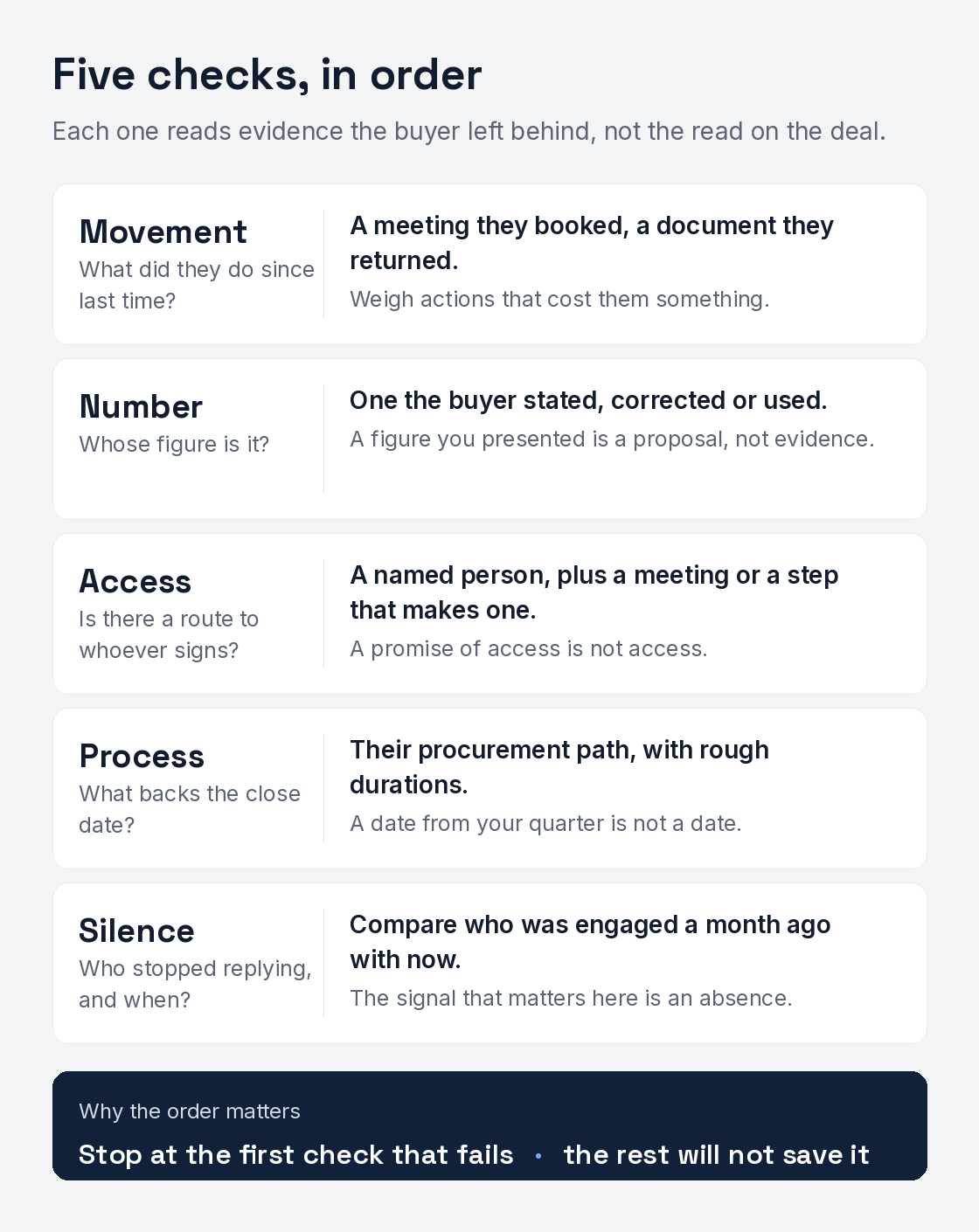
Run them in this order. The first disqualifies more deals than the other four together.
1. Movement. What has the buyer done since last time?
The quickest way to separate a progressing deal from a friendly conversation. Look for actions that came from them:
- They booked the next meeting
- They introduced a new stakeholder
- They shared internal information
- They completed something you asked for
- They built or reviewed a business case
- They pulled in finance, IT or procurement
- They committed to a specific date in writing
The important part is who did it, and what it cost them. A buyer attending a meeting you organised tells you something. A buyer organising a meeting with their own finance lead tells you considerably more, because that spends political capital and people do not spend it on a purchase they are not making.
If nothing meaningful has happened in two or three weeks, the deal has stopped rather than slowed, and it needs a different response.
2. Number. Whose figure is it?
Most opportunities have a business case somewhere. The question is where the numbers came from. Compare these two:
Weaker. "We calculated that you could save 500,000."
Stronger. "They told us they spend 1.2m on this today, and confirmed roughly 500,000 of it is addressable."
The second survives a meeting you are not in, because the person defending it is defending their own arithmetic. So the checks are whether the buyer has challenged the numbers, changed them, repeated them internally, or put them into something of their own. A figure in your slide is information. A figure the buyer uses to justify the purchase is evidence. That is the whole subject of how to write a business case your champion can defend.
3. Access. Is there a real route to whoever approves this?
Where a lot of strong-champion deals come apart. A champion can genuinely love the product and still be unable to get it bought.
A statement. "They will take it to the exec team."
A route. "Maria is presenting to the leadership team on 14 September, and asked for a one-page business case by Friday."
The second has a person, a date, an action and an artefact. That is something you can inspect.
4. Process. Is the close date connected to their buying process?
A close date on its own tells you very little. What matters is what happens between "we want to buy" and "the contract is signed", which in most organisations runs something like:
- Business approval
- Budget confirmation
- Security review
- Procurement
- Legal
- Signature
For each step: who owns it, has it been discussed, how long does it normally take, and what could delay it. If the best answer available is that it should be doable by 30 September, there is no process behind the date. There is a date.
5. Silence. Who has stopped engaging?
The easiest signal to miss, because CRMs record activity far better than they record its absence. Take the people who were involved a month ago and check who is still involved now.
Has the champion gone quiet? Did the promised introduction to finance never happen? Did a meeting get postponed without a new date being set?
Silence does not always mean the deal is dead. It does mean something changed and nobody has established what. This is also the check most improved by a second reader, because the person living inside the deal has usually grown used to it.
What looks like evidence, and what is evidence
| Looks like evidence | Stronger evidence |
|---|---|
| "They love it" | They took an action that cost them something |
| A highly engaged champion | The champion moved another stakeholder |
| Six people attended the demo | One of them owns the next step |
| A business case in your deck | The buyer validated or used the numbers |
| "Q4 is the target" | A defined process leading to signature |
| Regular communication | Communication that changed the state of the deal |
| "Procurement will not be an issue" | Procurement confirmed the steps and the timing |
Activity and progress are not the same thing. A buyer can be responsive, friendly and interested for months without ever getting closer to buying, and that combination is expensive precisely because it feels like a good deal.
Inspect before the forecast call, not during it
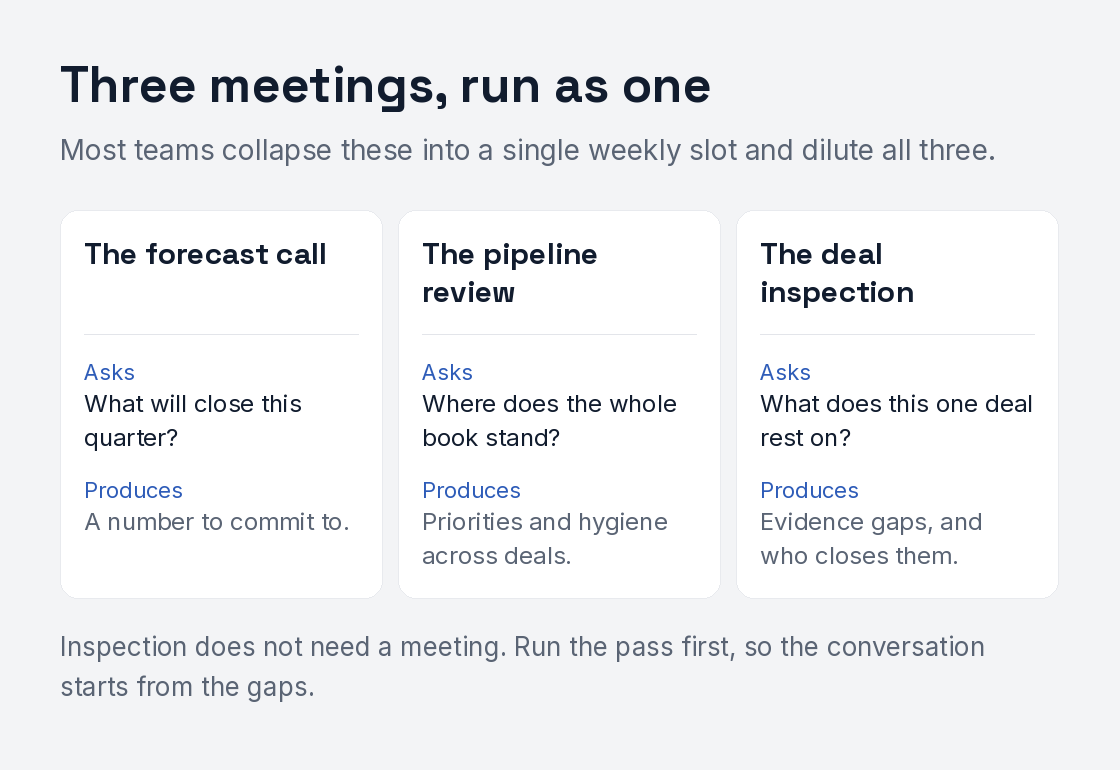
The common mistake is doing all of it in one weekly meeting. The team reviews the pipeline, talks through individual deals, debates the forecast and tries to coach, and by the time anyone reaches the deals that matter, forty-five minutes have gone.
Inspection does not need a meeting. Answer the five questions on the deals worth the time, in writing, beforehand: what moved, whose numbers, who approves, what their process is, and what has gone quiet. Then the conversation starts from the gaps instead of spending its first half discovering them.
On scope, inspect everything in commit, plus high-value opportunities, plus anything a rep has flagged. Inspecting every open deal in depth is how the practice gets abandoned in week three.
Turn every gap into an action
The inspection is not the point. Changing what happens next is.
No access to the economic buyer becomes: ask the champion who owns budget approval and agree an introduction before Friday.
No confirmed procurement process becomes: ask their procurement lead for the required steps, the owners and the expected timing.
Business case built only by the seller becomes: have the champion validate the assumptions and use the numbers in their own internal case.
Every gap that matters should produce an action, an owner and a date. Without that, inspection turns into another administrative exercise.
The manager's role in it
Good inspection is not about catching reps out, and the framing matters more than it sounds. A process that feels like an audit produces defensive answers, and defensive answers are worse evidence than no answers.
Complex purchases involve many stakeholders, competing priorities and internal politics that nobody sees fully from one seat. Gartner's 2025 survey of 632 B2B buyers found 74 percent of buying teams showed unhealthy conflict during the decision, in groups running from five to sixteen people across as many as four functions. The seller does not have perfect visibility into that. Neither does the manager. Two people reading the same evidence will see more than one person working from memory.
Which is why the useful version of the conversation sounds less like "why do you not have an economic buyer?" and more like "we have no route to whoever controls the budget, so what would create one?". Keep the problem on the deal.
Where Vektor fits
Vektor inspects the evidence on every opportunity continuously, from the CRM, emails, notes and documents the team already has. It separates what is established from what is assumed and what is still missing, names who to ask about the gaps, and updates the recommended moves as the deal changes.
The aim is a clear view of what is actually happening inside each opportunity, and the strongest available path to a win.
Key takeaways
- Deal inspection asks whether the evidence supports the deal. A forecast call asks what will close. Running the second without the first is where surprises come from.
- Pipeline inspection is the aggregate view. Deal inspection goes down into one opportunity, and the aggregate will never tell you a champion went quiet.
- Buyer actions outrank seller assumptions, and actions that cost the buyer something outrank the rest.
- A number in your slide is information. A number the buyer uses is evidence.
- A close date means little without a buying process behind it.
- A champion is not enough on its own. You need a named route to whoever approves the spend.
- Silence is a signal, and CRMs are poor at surfacing it.
- Every gap becomes an action with an owner and a date, or the inspection was administration.
FAQ
What is deal inspection in sales? Deal inspection is a structured review of a single opportunity to establish whether the evidence supports the deal. It examines buyer actions, financial justification, stakeholder access, the buying process, and changes in engagement, usually run by a manager as a second reader.
What is the difference between deal inspection and pipeline inspection? Pipeline inspection looks across the whole pipeline at coverage, stages, activity and hygiene, and Salesforce ships a feature by that name. Deal inspection goes deeper into individual opportunities and tests whether the story behind each one is supported by evidence.
What is the difference between deal inspection and forecasting? Forecasting asks which opportunities will close and when. Inspection examines the evidence behind those predictions, so it should come first. A forecast built on inspected deals is a decision rather than a guess.
Do you need call recordings for deal inspection? No. Recordings are one useful source among several, and the evidence that a deal is stalling is often an absence: a stakeholder who went quiet, a date with no process behind it, a business case nobody circulated. Inspection also runs from CRM activity, emails, calendar events, notes and documents.
How often should sales teams inspect deals? Weekly for anything in commit, plus high-value opportunities and anything showing an unusual change in activity. Inspecting every open opportunity in depth is unnecessary and is usually how the habit dies.
Who should conduct deal inspection? A sales manager, sales leader or RevOps. What matters is that someone outside the deal reads the same evidence and tests the assumptions, because the person inside it has usually normalised the gaps.
What should a deal inspection produce? A short list of gaps and the actions that close them, each with an owner and a date. If nothing changes on the deal as a result, the process has become administration.
How can a sales manager inspect deals without turning the weekly meeting into an audit? Run the pass in writing before the meeting and open the conversation on the gaps rather than on the rep. Keep the question on the deal, so it sounds like asking what would create a route to the budget holder rather than asking why no route exists. A process that feels like an audit produces defensive answers, and defensive answers are worse evidence than none.
We have no conversation intelligence and no plan to buy one, can we still inspect deals properly? Yes. The evidence that a deal has stalled is usually an absence, and absences do not appear in transcripts. A champion who stopped replying, a meeting postponed with no new date, a business case nobody circulated: all of that sits in the CRM, the calendar, the email thread and the documents a team already has.
Which signals tell you a deal has stopped rather than slowed, and how early do they appear? The clearest one is that no buyer-initiated action has occurred in two or three weeks. Others are a stakeholder who was active a month ago and is now silent, a close date that moves with no explanation, and a promised internal introduction that never happens. These are usually visible weeks before the deal is formally lost.
How can a manager running 15 to 30 open deals decide which ones are worth inspecting this week? Inspect everything in commit, plus high-value opportunities, plus anything a rep has flagged or that shows an unusual change in activity. Inspecting every open deal in depth is how the practice gets abandoned in week three, and the deals that produce quarter-end surprises are nearly always in that first group anyway.
Sources
- Challenger, The JOLT Effect research on customer indecision, from analysis of over 2.5 million sales conversations.
- Gartner, Survey Finds Sales Organizations That Provide AI-Enabled Next Best Actions Are 2.6x More Likely to Achieve Commercial Growth, May 2026, surveys of 227 chief sales officers and 645 B2B buyers.
- Gartner, Sales Survey Finds 74% of B2B Buyer Teams Demonstrate Unhealthy Conflict During The Decision Process, May 2025, survey of 632 B2B buyers.
- Salesforce, Pipeline Inspection, product documentation.
Related: How to write a business case your champion can defend · How to qualify a deal when the buyer is telling you what you want to hear · The 9 best AI deal coaching tools in 2026