The forecast call runs on a Thursday. Eleven deals in commit, a number at the bottom, and a conversation about three of them. The rep is asked whether the big one will land this quarter and says yes, probably, the champion is positive and the proposal is with them. Nobody in the conversation has spoken to the buyer. The number goes up to the board, and six weeks later the quarter comes in eleven percent under, mostly because of two deals that slipped rather than lost.
Everybody then discusses whether the reps were sandbagging or dreaming, which is the wrong question. The forecast was assembled almost entirely from things the selling side did, and it was then asked to predict something the buying side controls.
Gartner's State of Sales Operations Survey found that only 45% of sales leaders and sellers had high confidence in their organisation's forecasting accuracy, and only 47% believed their organisation held high-quality data. Those two numbers usually get quoted as a data hygiene problem. They describe something more structural than that.
What a forecast is a claim about
A forecast says that a group of people at another company will finish making a decision by a particular date, and that the decision will go your way.
Read as a claim about somebody else's internal process, the standard method looks strange. The inputs are a stage field, a close date and a probability, and all three are produced by the selling side. The buying side contributes almost nothing directly. They are represented in the model by a rep's interpretation of a conversation that happened eight days ago.
That works when the buying process is simple and visible. It degrades as the buying process gets longer, involves more people, and happens in places the seller cannot see.
Four reasons the number misses
1. The stage field records what the seller did
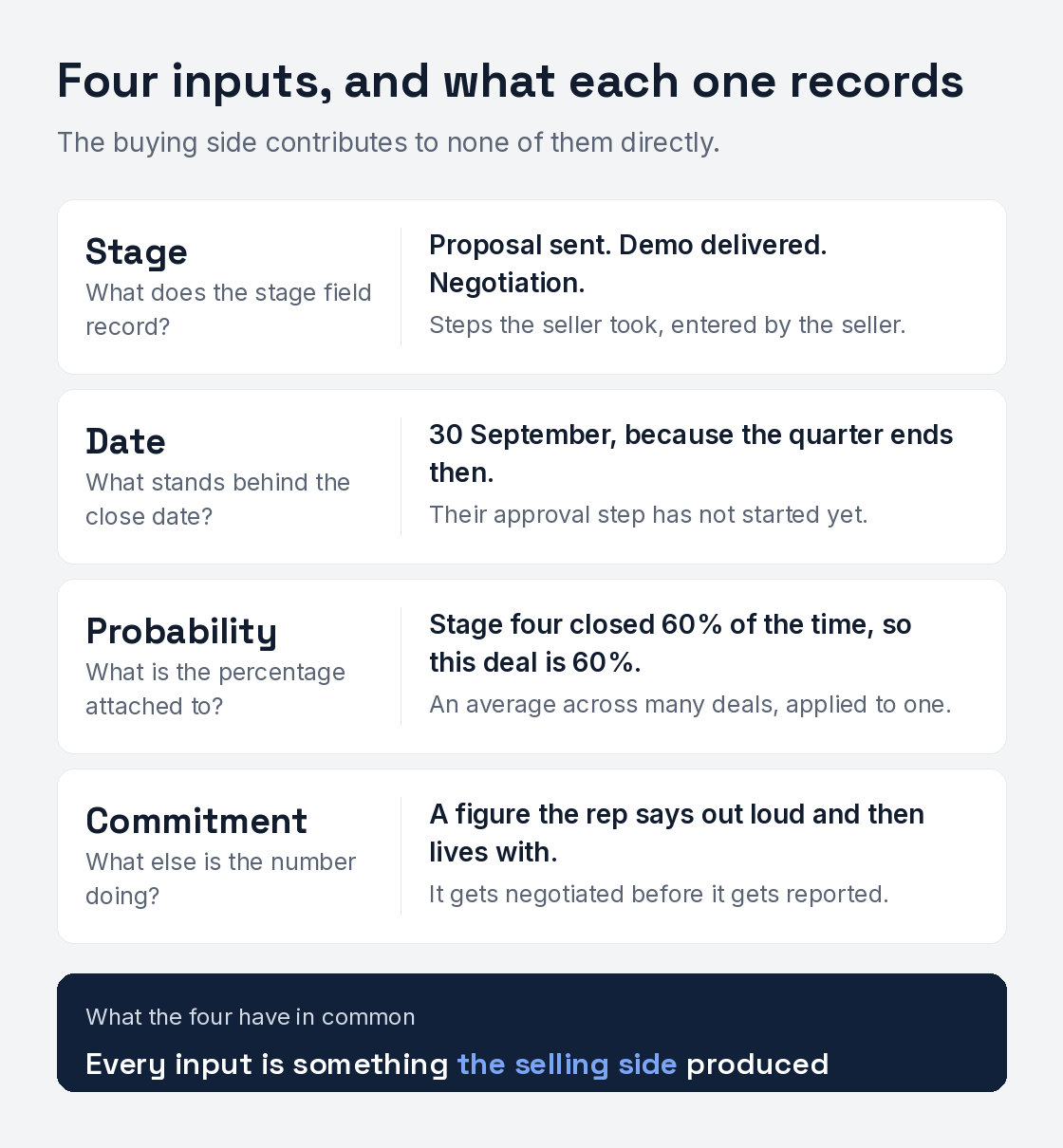
Most stage definitions describe seller actions. Proposal sent. Demo delivered. Negotiation. Each one advances when somebody on your side completes a task, which means the pipeline can move all the way to the final stage without the buyer doing anything except attending.
A stage that moves on buyer actions behaves differently. The buyer introduced the budget holder. The buyer returned the security questionnaire. The buyer put a date on their own internal approval step. Those are harder to fake and much harder to feel good about prematurely.
2. The close date stands on the quarter rather than on a process
Ask where a close date came from and the honest answer is often that it is the end of a quarter, adjusted by a few weeks when the deal has already slipped once.
A date is only worth something when there is a buying process behind it: who signs, what has to happen before they can sign, how long each of those steps took the last time this company bought something similar, and which of those steps has actually started. A close date with no process behind it is a wish with a calendar entry.
3. Probability describes a population, not this deal
Stage-based probability takes an average across many past deals and applies it to the one in front of you. If deals in stage four historically closed 60% of the time, this deal is entered at 60%.
The average is real. The problem is that it carries no information about this particular deal, and it sits there looking quantitative while doing so. Two deals in the same stage, one with a champion who went quiet three weeks ago and one with a signed procurement timeline, both arrive at 60%.
4. The forecast gets negotiated before it gets reported
This part rarely appears in articles about forecasting because it is uncomfortable, and every sales leader recognises it.
A forecast is a number somebody has to say out loud and then live with. That makes it a commitment as well as a prediction, and commitments get managed. A rep who was burned last quarter holds two deals back. A rep under pressure to show coverage leaves a deal in commit that they privately know is dead. A rep who had a warm call last week hears what they want to hear in it and moves the date forward.
All three are predictable, all three are common, and none of them are solved by asking for more honesty. The number is doing two jobs at once, and the second job distorts the first.
The seller now sees less of the buying than before
The four problems above are old. What has changed recently is how much of the buying process happens where the seller has no visibility at all.
Gartner surveyed 646 B2B buyers between August and September 2025 and found that 67% said they prefer a rep-free experience, and that 45% had used AI during a recent purchase. Buyers are researching, comparing and forming a view before they involve a seller, and increasingly they are doing it with a tool that never appears in your CRM.
The same pattern shows up inside the buying group. Gartner's May 2025 survey of 632 B2B buyers found that 74% of buying teams showed unhealthy conflict during the decision process. That conflict resolves in internal discussions no vendor attends, and its outcome determines your close date.
So the rep's read of the deal loses reliability for a structural reason rather than a skill one. A smaller share of the decision now passes through them.
The consequence is visible in how deals end. Analysis behind The JOLT Effect, drawn from more than 2.5 million sales conversations, found that 40 to 60% of lost deals end in no decision, with 56% of those associated with customer indecision rather than a competitor. Those deals do not announce themselves. They sit in commit at 60% while nothing happens, which is exactly what a stalled deal and a healthy deal look like in a stage field.
What a deal has to show before it belongs in commit
Three questions, and a deal that cannot answer all three belongs in best case at most.
Has the buyer done something that cost them? Attending a meeting and sounding enthusiastic are free. Booking something, introducing someone, returning a document or putting their own name against a date all cost the buyer time or political capital, and those are the actions that carry information.
Is there a dated step in their process, set by them? Their legal review, their security review, their board meeting, their budget cycle. If your close date rests on a step that has not started, and the last time this company ran that step it took five weeks, your date is already wrong and you can see it now rather than in October.
Is there a named person who has to act next, on their side? A deal where the next action belongs to you is a deal you have not yet transferred. Forecasts fail on the deals where the seller is the only one doing anything.
The same March 2026 Gartner research found that buyers with high decision confidence were roughly twice as likely to report a high-quality deal as buyers with low confidence. Confidence on their side is the thing your date depends on, and it is not observable from a stage field.
A better question for the forecast call
Replace "will it close" with "what has to happen for this to close, and which of those has started".
The first question invites a judgement, and judgements are what get negotiated. The second asks for a list, and a list is checkable. It also turns the forecast call into something useful for the rep rather than an exam: the gaps it exposes are the actions for the coming week, which is where a pipeline review picks it up.
Forecast accuracy improves as a by-product when the underlying read of each deal improves. Accuracy is not really a forecasting problem, and treating it as one is why so many teams buy a forecasting tool and still miss the quarter.
Where Vektor fits
Vektor does not produce the forecast number and it does not replace the one in your CRM. It changes what the number is built from.
Every input described above was produced by the selling side: a stage the rep advanced, a date chosen to fit the quarter, a probability inherited from an average, a figure negotiated on a call. Vektor reads each open deal against the evidence instead. What the buyer did, when they last moved, which promised step carries no date, which thread stopped replying and how long ago. It reads the silences as well, because a deal that has quietly stopped produces no record of stopping.
Each deal then arrives at the forecast call with a state that can be checked rather than a number that has to be trusted.
A commit list built on buyer evidence can be audited. A commit list built on how the last conversation felt cannot.
So a manager can see, before the call rather than after the quarter, which commit deals have buyer-side movement behind them, which are resting on a stage field, and which have nobody named on the buyer's side who has to act next. The conversation then starts from what the deals show rather than from how the last call felt to the person who was on it.
Optimism in a forecast is not a flaw in a particular rep. It is a predictable feature of any number that doubles as a personal commitment, and it does not go away because somebody asks for realism. It goes away when the commit decision rests on what the buyer has done.
Key takeaways
- A forecast is a claim about when other people will finish deciding, assembled almost entirely from inputs the selling side produced.
- Stage definitions usually track seller tasks, so a deal can reach the final stage without the buyer doing anything.
- A close date means little without a buying process behind it, including which steps have started and how long they took last time.
- Stage-based probability applies an average from many deals to one deal it may not describe.
- Forecasts are commitments as well as predictions, so they get negotiated before they are reported. Better arithmetic does not solve that.
- 67% of B2B buyers say they prefer a rep-free experience, so the share of the decision the rep can observe is falling.
- Deals that end in no decision look identical to healthy deals in a stage field, and they are the largest category of loss.
- Before a deal sits in commit it should show a buyer action that cost them something, a dated step in their own process, and a named person on their side who acts next.
FAQ
Why are sales forecasts so often inaccurate even when the CRM data is clean? Because clean data is not the same as predictive data. A tidy CRM records stages, amounts and close dates accurately, and all three describe what the selling side did and intends. The buying side is represented only through a rep's interpretation of it. You can have perfect hygiene on inputs that were never capable of predicting when another company will finish deciding.
What is the difference between forecast accuracy and pipeline quality? Forecast accuracy measures how close the predicted number lands to the actual one. Pipeline quality describes whether the deals in it are real, meaning the buyer is genuinely progressing towards a purchase. Accuracy is downstream: a forecast built on a pipeline nobody has inspected is a well-calculated number resting on unverified claims.
Should we stop using stage-based probability for forecasting? It is useful for aggregate planning across hundreds of deals, where averages behave. It becomes misleading when applied to a single deal and read as that deal's chance of closing, because it carries no information specific to it. Many teams keep the stage percentages for roll-up and make commit decisions on evidence rather than on the percentage.
How do I get my reps to forecast more honestly? Change what the number is used for before changing how it is produced. A forecast that functions as a personal commitment will be managed by the person committing to it, which is a rational response rather than a character issue. Asking what has to happen for a deal to close, and which of those steps has started, produces a checkable list instead of a judgement that has to be defended.
What is the single biggest cause of deals slipping out of a forecast? Close dates set without a buying process behind them. The date is chosen for the quarter, not derived from what the buyer has to do: their legal review, their security review, their approval cycle. When those steps take the time they were always going to take, the deal slips, and the slip was visible weeks earlier to anyone who had asked which of those steps had started.
I want software that tells me which deals in commit are actually at risk rather than giving me another forecast number, what options exist? Forecasting tools such as Clari roll structured signals into a number and show how it trends, which answers a different question. Conversation intelligence tools such as Gong surface risk from what was said on recorded calls. Deal intelligence tools, Vektor among them, read the state of each deal from CRM, email and calendar activity, including the absence of activity, and flag the commit deals with no buyer-side movement behind them. The choice depends on whether your risk tends to surface in conversations or in silence.
How can a sales manager improve forecast accuracy without buying a forecasting tool? Inspect the commit deals before the forecast call rather than during it, and apply the same three tests to each: a buyer action that cost them something, a dated step in the buyer's own process, and a named person on their side who acts next. Most of the inaccuracy in a forecast sits in a small number of deals that fail all three, and they can be found in an hour.
We keep losing deals to no decision, how would that show up in a forecast before it happens? It usually does not show up at all, which is the difficulty. A stalling deal and a progressing deal look the same in a stage field, because neither the stage nor the close date changes when a buyer quietly stops moving. The earliest signals are absences: a champion who used to reply within a day, a promised internal introduction that never happened, a business case nobody has mentioned since.
Does AI in the buying process make forecasting harder? It shifts more of the decision out of the seller's view. Gartner found that 45% of B2B buyers had used AI during a recent purchase, and 67% say they prefer a rep-free experience. Research, comparison and shortlisting increasingly happen before a seller is involved and without leaving any trace in a CRM, so a forecast built on rep-observed activity is describing a smaller share of the process than it used to.
We miss our forecast almost every quarter, what is actually causing it? In most teams it concentrates in a handful of deals rather than spreading evenly across the pipeline, and those deals share a profile: a close date chosen to fit the quarter, a stage that moved on something the seller did, and no dated step in the buyer's own process. A persistent miss is rarely a maths problem in the roll-up. It is usually the same few deals failing the same three tests every quarter, and the pattern becomes visible as soon as somebody inspects commit before the call instead of explaining the gap afterwards.
I need help with our sales forecast and I am not sure where to start, what should I look at first? Start with the commit list and ignore the total. For each deal, find one buyer action that cost them something, one dated step in the buyer's own process, and one named person on their side who has to act next. Deals missing all three are where the miss will come from, and in most pipelines there are only a few of them. That exercise takes about an hour and it tells you more than changing the stage percentages or buying a tool to recalculate the same inputs.
How far ahead can a B2B sales forecast realistically be accurate? Accuracy tends to hold roughly as far out as the buyer's own process is dated. If the buyer has a scheduled approval step in six weeks, a six-week view is grounded. Beyond the last dated step in their process, the forecast is extrapolation, and the sensible response is to say so rather than to attach a percentage to it.
Sources
- Gartner, Gartner Says Less Than 50% of Sales Leaders and Sellers Have High Confidence in Forecasting Accuracy, from the State of Sales Operations Survey.
- Gartner, Sales Survey Finds 67% of B2B Buyers Prefer a Rep-Free Experience, March 2026, survey of 646 B2B buyers conducted August to September 2025.
- Gartner, Sales Survey Finds 74% of B2B Buyer Teams Demonstrate Unhealthy Conflict During The Decision Process, May 2025, survey of 632 B2B buyers.
- Challenger, The JOLT Effect research on customer indecision, from analysis of over 2.5 million sales conversations.
Related: How to run a pipeline review that produces actions, not updates · Deal inspection: how to know if a sales deal is actually moving · Deal intelligence: the third layer your sales stack is missing