Most enterprise and mid-market deals that fall apart late were never real. The warning signs were sitting there from the first few meetings: no economic buyer in sight, a problem nobody had put a number against, a champion who would not set up a stakeholder meeting. The rep kept investing anyway, because the buyer kept engaging, and engagement felt like progress.
Engagement is not progress. Qualification is the discipline that tells you the difference.
Why most qualification frameworks lie to you
Every framework you have been taught works the same way. BANT asks: do you have Budget, Authority, Need, a Timeline. MEDDPICC asks a longer list. They hand you questions and you interrogate the buyer against them.
The problem is that every one of those questions can be answered with words. "Yes, there's budget." "Yes, I'm the decision-maker." "We want this live by Q2." Words are free, and words are exactly where deals lie to you, usually without anyone meaning to. A buyer who wants to keep the option open will tell you what keeps you engaged.
So stop qualifying on what the buyer says and start qualifying on what the buyer does. A deal is real to the exact degree the buyer is building it with you. Are they quantifying their own problem? Are they spending their own political capital to get you in front of the people who decide? Is the champion doing concrete things between meetings, or just turning up to them? A buyer who is co-authoring the deal leaves evidence. A buyer who is only engaging leaves you doing all the work and calling it pipeline.
That reframes qualification from a checklist you fill in to a question you answer with evidence: how much of this deal is the buyer building, and how much are you building alone and hoping they follow.
A deal is real to the exact degree the buyer is building it with you.
The five checkpoints, scored on evidence
The checkpoints below are the same areas MEDDPICC covers. The difference is the bar. You do not pass a checkpoint because the buyer gave you a good answer. You pass it because the buyer did something only a real buyer would do.
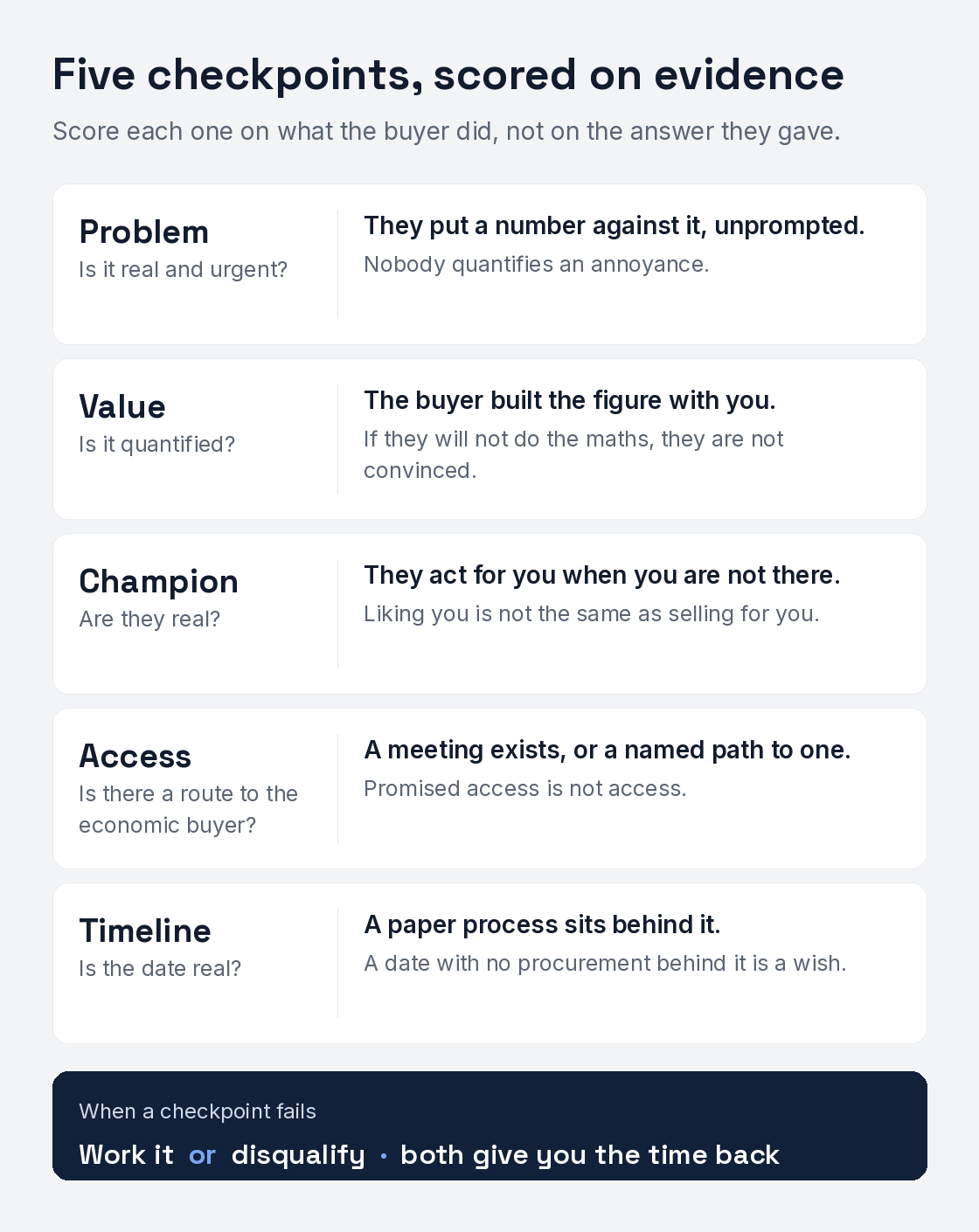
Score every open deal against the five checkpoints. Any one you cannot mark green is where the deal is most likely to break.
1. Is the problem real and urgent?
The tell is not how much pain the buyer describes. It is what they have already done about it. A problem that genuinely matters has a history: someone scoped it, ran a workaround, or asked for budget before you ever showed up. A problem nobody has lifted a finger on is not urgent, whatever the buyer says on the call.
- "What have you already tried to fix this, and what happened?"
- "What put this on your roadmap this quarter rather than six months ago?"
- "Whose targets are on the line if this stays the way it is?"
the buyer has already spent time, money, or political capital on the problem. A problem with no prior action is a research project. Qualify it out or drop it into nurture.
2. Is the value quantified, and did the buyer build the number?
This is the checkpoint most reps skip, and it is the one that kills deals in front of finance. A pain you have surfaced but never put a number against is not a qualified deal. It is a conversation.
But quantifying it yourself is not enough either. The number that survives is the one the buyer helped build, in their own metrics. When the champion carries your business case to the people who control budget, a figure you handed them gets challenged as vendor maths. A figure they helped calculate gets defended as theirs.
The number that survives finance is the one the buyer helped build.
- "How are you measuring this problem today, in time, money, or risk?"
- "If we fixed this, what would that be worth over a year, in numbers you would take to finance?"
- "What does the person who signs off need to see to say yes?"
the buyer engages with the numbers, corrects your assumptions, and ends up with a business case in their own language. If they will not do the maths with you, they are not yet convinced it is worth solving, whatever they say.
3. Is the champion real?
A champion is not the person who likes you. It is the person who does work for you when you are not in the room. The fastest test is to ask them to do something concrete: set up a meeting with the economic buyer, send an internal email carrying the business case, book a review with their security team. A real champion does it. An enthusiast agrees and then nothing happens.
Champion quality is the single biggest variable in an enterprise deal. Get it wrong and everything else is built on sand. There is a full treatment in how to build a sales champion who can sell without you.
4. Do you have a path to the economic buyer?
You do not need to have met the economic buyer to clear this. You need to know who they are and to have seen your champion act to get you closer to them. A champion who keeps you away from the real decision-maker is telling you something, usually that they are not as influential as they claimed, or not as sold as they seem.
- "Last time you approved a purchase at this level, what was the process?"
- "Who else has to be part of this decision?"
- "Whose budget would this come out of?"
doors actually open. You get the meeting, the introduction, the name. If your champion cannot or will not move you toward the decision, you cannot forecast the deal and you cannot protect it from a late blocker.
5. Is the timeline real?
Enterprise buyers are optimists about timing. They want it live before kickoff. They will decide before year end. Most of those dates are aspirational. The operational timeline is set by the paper process, procurement, legal, security review, budget cycle, and a real buyer will walk you through theirs.
- "To hit that date, when does procurement need the contract in hand?"
- "Is there a budget freeze coming that we would need to get ahead of?"
- "How long does your legal usually take on a vendor contract?"
the buyer exposes their real process, dates, blockers and all. A timeline with no paper process behind it is a number your champion picked to give you something to chase.
What this looks like in a real deal
The biggest deal I ever closed was not the one where the buyer was most enthusiastic. It was the one where the champion built the business case himself. I gave him a rough model. He took it, rebuilt it in his own numbers, walked it through his CFO without me in the room, and came back with the budget already half-defended. By the time it reached procurement, the deal was his to win, not mine to sell. Every checkpoint was green because he was the one filling them in.
The worst loss looked the opposite, and it looked healthy the whole way. Constant engagement, warm calls, a contact who loved the product. But he never quantified anything, never put us in front of the person who controlled the budget, never did a single concrete thing between meetings. I kept it in the forecast because the engagement felt real. The authorship never was. It never reached a real decision: the date slipped once, then again, then he went quiet, and the next quarter the priority had moved on without us. I had seen none of it coming because I was reading engagement instead of action.
The difference between those two deals came down to one thing: who was building the deal.
Qualifying out is a win
The hardest move in qualification is walking away from a deal you have already worked. Sunk cost is a powerful drug, and most reps keep pushing because stopping feels like losing. Treat disqualification as a good outcome. A deal you let go of early hands its resources straight back to your pipeline. The same deal lost at the finish line cost you everything you spent getting there.
Say it plainly: "From what I am seeing, I do not think the conditions are right for this to move now. I would rather tell you that than keep us both invested in something that is not ready." A buyer who is really building with you will use that to get unstuck. One who is only engaging will let it drift, and that tells you what you needed to know.
Where Vektor fits
Qualification fails when the evidence is sitting in the deal and nobody connects it. Vektor reads every deal for the signals that the buyer is building with you or just engaging: the pain nobody has quantified, the champion who has not done anything concrete, the economic buyer you still cannot reach, the timeline with no process behind it. It turns qualification from a thing you remember to do into something that runs on every deal, and points you at the next move that tests whether the buyer is real. See how it works on the platform page, or start free.
Key takeaways
- Qualify on what the buyer builds, not what they say. Words pass a checklist; only action and authorship are real evidence.
- The strongest qualification signal is the buyer quantifying the problem in their own numbers. If they will not do the maths with you, they are not convinced it is worth solving.
- A champion is defined by what they do for you when you are not in the room, not by how much they like you.
- The five checkpoints are real and urgent problem, quantified value, real champion, a path to the economic buyer, and a real timeline. Score each on evidence the buyer acted, not on the answer they gave.
- Disqualifying early is a win. It returns time and resource to the deals where the buyer is actually building with you.
FAQ
What is enterprise deal qualification? Enterprise deal qualification is the ongoing practice of validating whether a deal is real, winnable, and worth the investment, judged on what the buyer actually does rather than what they say. The same checkpoints apply to mid-market deals; the more complex the buying group, the more they matter.
How is this different from MEDDPICC? MEDDPICC gives you the areas to check. It does not tell you that a good answer in each area is worthless if the buyer is not acting on it. This approach uses the same areas but raises the bar from "the buyer answered" to "the buyer did something," which is a far harder thing to fake.
When should I qualify an enterprise deal? Continuously, never as a one-time gate. Your read should get sharper as the deal matures. If you understand it less well now than at the start, something has gone wrong.
What are the signs an enterprise deal is not real? Plenty of engagement and no authorship: a problem nobody has quantified, a champion who will not do concrete things, no movement toward the economic buyer, and a timeline with no paper process behind it.
How can a sales team qualify deals on evidence when the buyer keeps giving encouraging answers? Stop weighting answers and start weighting authorship. Encouraging answers cost the buyer nothing, so they carry almost no information. What the buyer builds, quantifies, circulates or introduces you to costs them something, and people do not spend political capital on a purchase they are not making.
We use MEDDPICC and deals still slip, what is the framework missing? Nothing in the framework itself. The usual failure is treating the letters as fields to complete rather than as claims to evidence. A filled-in economic buyer field records that somebody typed a name. What matters is whether there is a named route to that person, with a date and an artefact attached, and the framework does not enforce that distinction on its own.
Which buyer actions actually indicate a deal is real, as opposed to a buyer being polite? Actions that cost them time, effort or internal standing. Booking the next meeting themselves, introducing a new stakeholder, sharing internal information, quantifying the problem in their own numbers, pulling in finance or procurement, and committing to a specific date in writing. A buyer attending a meeting you organised is the weakest of these by some distance.
How can a founder-led sales team qualify deals without a full sales process in place? The evidence test works without any process at all, because it asks what the buyer did rather than what stage anyone selected. Write down, per deal, what the buyer has done since the last conversation, whose numbers are in the business case, and who has to approve the spend. Three questions with honest answers will disqualify more deals than a stage model will.
Related: How to run discovery that pays off at every stage of the deal · Deal inspection: how to know if a sales deal is actually moving · How to write a business case your champion can defend