Most sales discovery calls end with a full notebook and a good feeling. Neither one moves the deal.
Here is the question that exposes whether your discovery was any good: not "what did I learn," but "what did the buyer do." A buyer can answer questions for forty minutes, invest nothing, and leave the deal exactly where it was. The information moved. The deal did not.
So measure discovery by what the buyer does, not by what you ask. Answers are cheap. Actions are not. And the three actions good discovery produces are the same three things every later stage of the deal will need.
One thing to hold onto before we start, because it is the mistake underneath most of the others: discovery is not the first meeting. It is something you keep doing as the deal changes.
Discovery is measured by what the buyer does, not by what you ask.
First, earn the right to ask
A sharp question asked too early, by someone who has not earned it, lands as an interrogation. And people close up under interrogation. The call becomes question, answer, next question, the answers get shorter, and by the end the boxes are ticked and nobody understood anything.
You earn the right to ask the questions that matter, and all of it happens before the hard ones.
Do the homework. Never ask what the buyer has already made public. Asking what they sell, who their customers are, or what they announced last quarter signals you did not prepare, and from there every question feels like work you are outsourcing to them. Come in already knowing the obvious. The operational numbers you actually need to size the value, like team size, deal volumes, or what a process costs them, are a different thing entirely. Those are not homework, they are the discovery, and you should ask them directly.
Interrupt the pattern they expect. A buyer walks into a discovery call braced for the usual script: a little forced rapport, a run of feature questions, then a pitch. They have a defence ready for each one. The way through is a pattern interrupt, something that breaks the script they are bracing against. Lead with a sharp observation about their business they did not expect you to have. Ask the question no other rep has asked them. Be honest about where you might not be a fit. The moment you stop sounding like every other seller, they stop performing the buyer role and start actually talking.
Set the frame out loud. Open by naming what you would like to get to together, and check that they are good with it. Something like: "I would like to understand how this actually works for you today, and where it is costing you, so I do not waste your time pitching the wrong thing. Does that work?" Now the questions are a shared agenda, not a cross-examination.
Then react like a human. Discovery dies the moment it becomes a list being worked through. After each answer, say what you heard, react to it, and go one layer deeper on the part that matters. The buyer should leave the call understanding their own problem better than when they got on it. That feeling is what makes them willing to give you the three things that actually move the deal.
The three outputs of real discovery
The discovery questions that matter all work toward one of three outputs. Discovery is finished, for now, when you can fill in three blanks. If any one is empty, you interviewed the buyer, you did not advance the deal.
1. A number they said
Not a number you supplied. A figure, in the buyer's own words, for what the problem costs them. "Onboarding is slow" is a complaint with no budget behind it. "Slow onboarding costs us about twelve deals a quarter, and it gets worse as we grow" is a business case. The work is to take one real problem all the way to a number the buyer says out loud, because a number they said is a number they will defend internally. A number you gave them is a number they will argue with.
- "Where does this break down most, and what happens when it does?"
- "When it goes wrong, who has to deal with it, and how long does that take them?"
- "If nothing changes here, what does that cost you over the next year?"
- "How would you measure the difference if it were fixed?"
2. A map they drew
How a decision like this actually gets made here: who owns the budget, who can quietly kill it, what approval really looks like, and where the last project like this got stuck. Most reps learn the real decision process in the final week of the deal, which is exactly when unmapped deals fall apart.
- "How did the last decision like this actually get approved here?"
- "Besides you, who has to be comfortable before this moves?"
- "Where do projects like this usually get stuck?"
3. A step they took
A concrete commitment that costs the buyer something and proves they are serious: a date, an introduction to the economic buyer, agreement to pull in a stakeholder. This is the difference between a deal that is moving and a deal that is merely active. If a buyer will not spend anything after a genuinely useful conversation, that is discovery too, and it is telling you something you need to hear now rather than in month four.
- "Based on this, the sensible next move is X. Can we get it on the calendar now?"
- "Who would need to be in the room for that, and can you make the introduction?"
All three are buyer actions, not buyer answers. That is the whole point. Anyone can get a prospect to talk. Good discovery gets them to quantify, reveal, and commit.
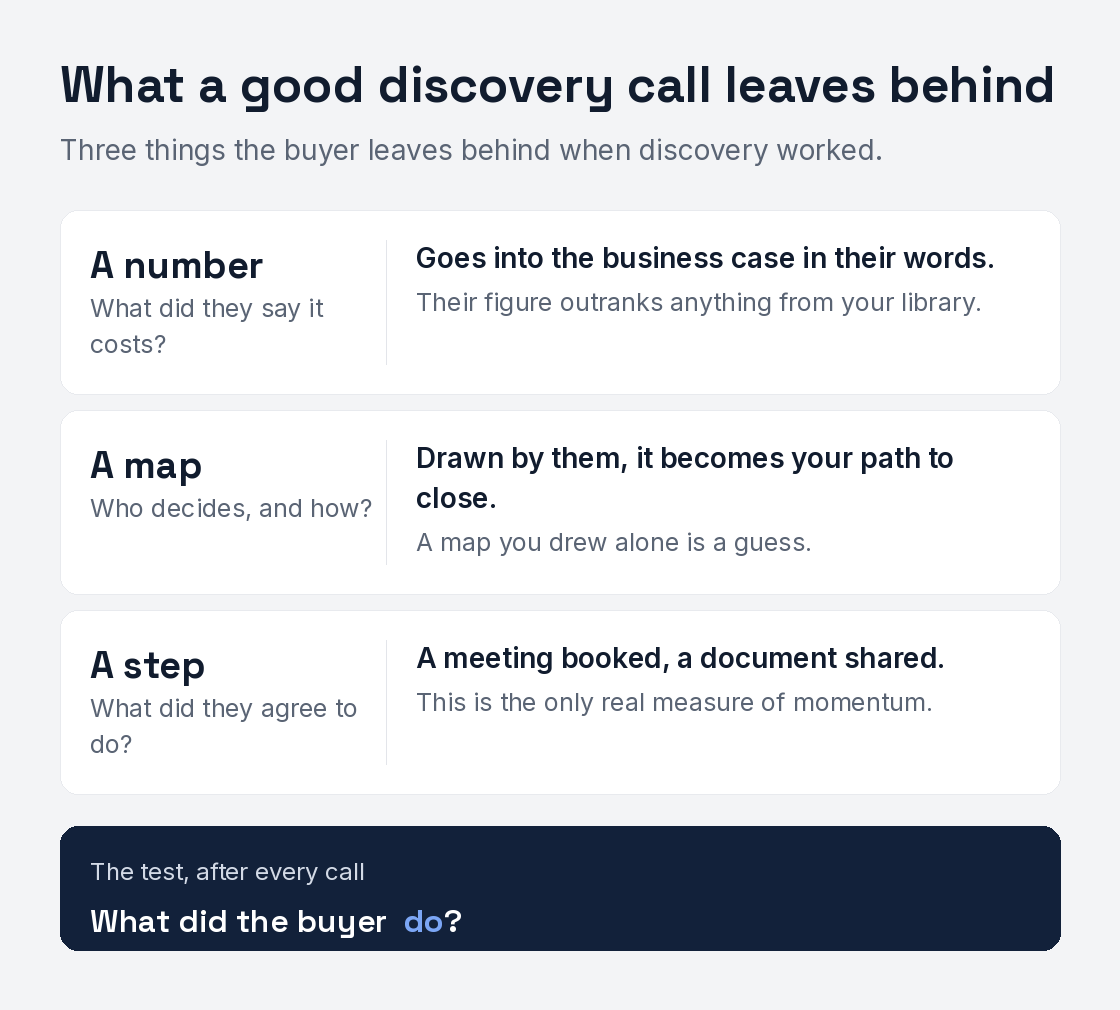
Good discovery produces three things, all of them buyer actions rather than answers. Each one becomes the raw material for a later stage of the deal.
Discovery is a loop, not a milestone
The biggest mistake in B2B discovery is treating it as the first call you tick off and move past. Deals do not hold still. A new stakeholder appears, priorities shift, budget moves, a competitor gets involved, your champion changes role. Any one of those can quietly invalidate something you were sure of a month ago.
So strong reps never really close discovery. They reopen it every time the deal moves: what changed, what does it mean, and what do I now need to re-confirm. The three outputs are not one-time captures. The number gets revisited as the scope changes. The map gets redrawn as people move. The next step gets re-earned at every stage.
A deal built on what you learned in month one is running on out-of-date information.
That is exactly how something that looked safe falls apart late. Holding the picture current across a long deal, knowing what changed and what it means for your next move, is hard to keep in your head over a full pipeline. It is the part most reps quietly let slide, and it is where deals are lost without anyone noticing.
Discovery debt: why skipping the work compounds
Anything you fail to uncover does not disappear. It becomes debt, and you pay it back later in the deal with interest.
Skip the number, and your business case has nothing to stand on. When it is time to justify the spend, you are inventing value or quoting a generic stat instead of handing back the figure the buyer gave you. That is debt you pay at the value stage.
Skip the map, and you meet the real decision-maker for the first time at the close, when there is no time left to win them. That is debt you pay at the closing stage.
Skip the step, and the deal drifts on good feeling until a more urgent priority quietly buries it. That is debt you pay every week the deal stays "active" without moving.
This is why a deal that felt great in discovery can die three months later for no obvious reason. The cause of death was almost always a discovery output that was never produced, or one that went stale and was never refreshed. Good discovery is not a tax you pay once at the start. The deal keeps moving, and anything that changes without you going back to re-discover it becomes fresh debt.
The output check
You do not need a longer question list. You need a habit. After every discovery conversation, before you write the recap, fill in three lines:
- The number the buyer said
- The decision map they drew
- The step they committed to
Any blank is your agenda for the next call. A recap full of insight but with three blank lines is a warning, not a win. It means you had a good conversation and an unmoved deal.
Where Vektor fits
Discovery fails when the picture goes stale and nobody refreshes it. Vektor keeps this discovery live on every deal: what the buyer has quantified, how the decision really works, and what has changed since last time, so your next move is based on the deal as it is now, not as it was on the first call. It also surfaces what is still missing, the number nobody has put on the problem, the stakeholder you have not mapped, so the gaps never get a chance to become debt. See how it works on the platform page, or start free.
Key takeaways
- Measure discovery by what the buyer does, not by what you ask. Notes are not progress.
- Earn the right first: do the homework, interrupt the pattern they expect, set the frame out loud, and react like a human.
- Every good discovery produces three things, all buyer actions: a number they said, a map they drew, a step they took.
- Anything you fail to uncover becomes discovery debt that you repay at a later stage, with interest.
- Discovery is a loop, not a milestone. Rerun it every time the deal changes, because month-one answers are rarely still true in month three.
FAQ
What makes a good discovery call? A good discovery call is measured by what the buyer does, not by what you ask. It should end with three things only a serious buyer would give you: a cost they put on the problem in their own words, an honest map of how the decision really gets made, and a concrete next step they commit to. A full notebook with none of those is a conversation, not progress.
How is this different from a list of discovery questions? A question list tells you what to ask. It does not tell you that a good answer is worthless if the buyer takes no action on it. This approach works backward from the three outputs you need and treats the questions as the means to get them, not the goal.
How often should you run discovery? Continuously, never as a one-time gate. Deals change as stakeholders, budgets, and priorities move, and each change can invalidate something you thought you knew. Reopen discovery every time the deal moves and re-confirm what changed.
What is discovery debt? Discovery debt is the cost of anything you failed to uncover, or failed to keep current. It does not disappear. It shows up later as a business case with no number, a decision-maker you met too late, or a deal that stalls for no clear reason, usually at the worst possible time.
How can a rep tell whether a discovery call went well, beyond the call feeling positive? Judge it on what the buyer did rather than on how the conversation felt. A good call ends with something the buyer has agreed to do, a number they supplied or corrected, and a name they offered. A call that felt excellent and produced none of those three has told you very little.
What should a discovery call produce that a manager can inspect afterwards? Three things: a problem stated in the buyer's own numbers, a named next step with a date the buyer agreed to, and at least one new person or constraint you did not know about beforehand. Those are checkable by somebody who was not on the call, which is what makes them useful.
How can a sales team keep doing discovery after the first call without annoying the buyer? Attach it to something the buyer wants rather than running it as a second interrogation. Reviewing a business case together, preparing them for an internal meeting, or working through a procurement step all require new information and give the buyer a reason to supply it. Discovery framed as your own information-gathering is what wears thin.
We ask good questions and still lose deals to no decision, what is missing from our discovery? Usually the risk side. Questions aimed at the problem establish that a problem exists, which is not the same as establishing that the buyer can survive the decision internally. What is missing is normally who else has to agree, what happens to them if the purchase goes badly, and what the buyer would have to stop doing to make room for it.
Related: How to qualify a deal when the buyer is telling you what you want to hear · The pattern interrupt: how to break the script your buyer is braced for · Deal intelligence: the third layer your sales stack is missing