Two deals in the same pipeline have been quiet for three weeks. Both are in late stage, both have a champion who was enthusiastic in August, both still carry a close date this quarter. One is waiting on a security review that takes six weeks at a company that size. The other was deprioritised in a planning meeting nobody invited a vendor to.
In the CRM they are the same deal. Same stage, same amount, same silence. The rep will usually treat them the same way too, with a follow-up email on Tuesday, because the pipeline offers no way to tell them apart.
A stalled deal is one where no step is running on the buying side. A slow deal is one where a step is running and it takes the time it takes. The distinction matters more than almost anything else a seller can know about a quiet deal, because the two call for completely different work, and getting it wrong wastes weeks the quarter will not give back.
Why the CRM cannot tell them apart
A CRM records events. A meeting happened, a proposal went out, a stage changed, a note was written. Every one of those is something that occurred, and almost every one was done by the selling side.
A stalled deal is defined by the opposite. Nothing occurred. There is no field for the introduction that was promised and never arrived, no record of the legal review that was supposed to start a fortnight ago, no timestamp on the moment a champion stopped replying within a day and began replying within five. The CRM is silent about the silence.
So both deals present the same way: a stage that has not moved, a close date that has not changed, and a last-activity date that is three weeks old. The record is accurate and it is useless for this question.
A CRM is a log of what happened. A quiet deal is defined by what did not.
The clock test
Every quiet deal has a clock, or it does not. Naming who holds it resolves the question faster than any amount of staring at the activity feed.
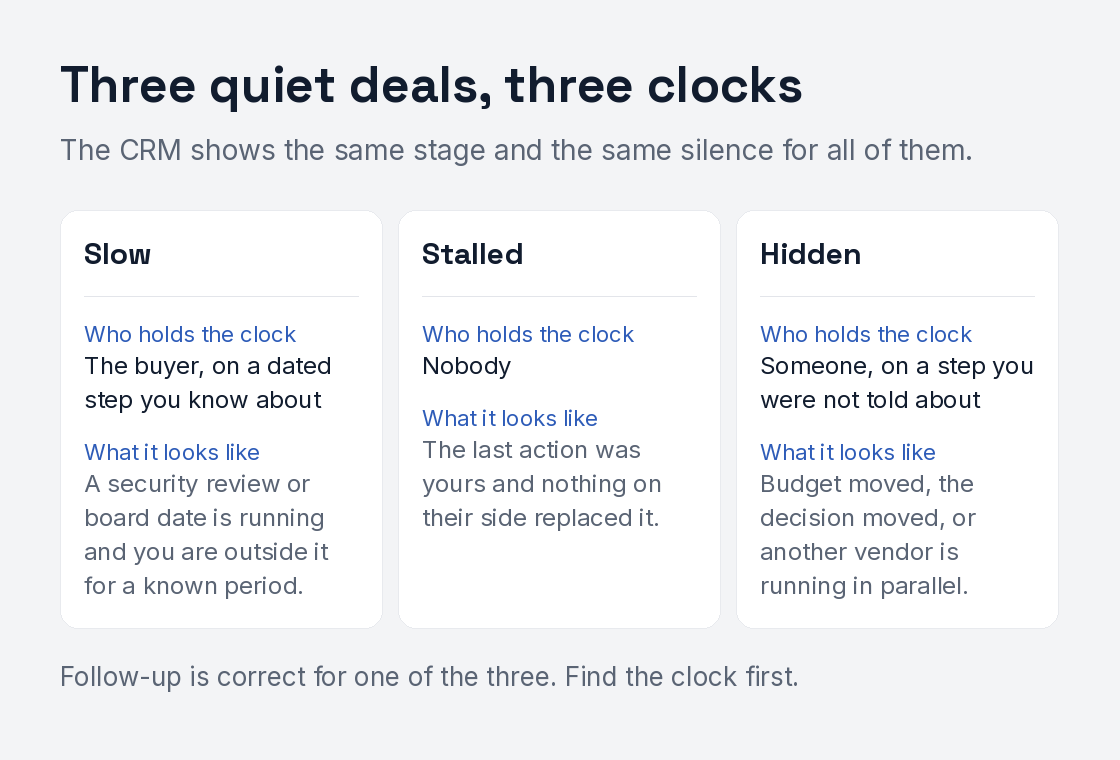
Slow. The buyer is inside a step with a duration: a security review, a legal review, a procurement cycle, a board meeting with a date on it. You know the step exists because they told you, and ideally you know roughly how long it took the last time this organisation did it. Silence here is the expected condition and the end of it is predictable.
Stalled. Trace the deal backwards and the last thing that happened was something you did. You sent the proposal. You followed up. You sent the case study. Nothing on their side has moved since, and no step with a name and a date is running. The deal has dropped out of the buying process rather than paused inside it.
Hidden. The hardest of the three and the most expensive. Something is running: a competing internal project absorbed the budget, a reorganisation changed who decides, another vendor ran a parallel evaluation, or the buying group reached an outcome in discussions you never saw. Gartner's May 2025 survey of 632 B2B buyers found that 74% of buying teams showed unhealthy conflict during the decision process. That conflict gets resolved somewhere, and a seller is almost never present for it.
A hidden clock produces exactly the same symptom as a stalled deal, which is why the test is a sequence rather than a single question. Rule out a running step you know about, then rule out a running step you do not.
Reading which one you have
The evidence is already in your email, your calendar and your CRM. It is just distributed across three systems and none of them is asking the question.
Who acted last, and was it you? Scroll the thread to the most recent message that was not yours. If every one of the last four actions belongs to your side, the deal has no momentum of its own, whatever the stage field says.
Has their reply latency changed? A champion who answered within a day in August and now answers within six days has told you something, and they have told you without writing it down. The change is the signal rather than the absolute number, because some buyers are always slow.
Is there a named step with a date, given by them? Not "they said procurement will take a while". A step, a name, an owner, and either a date or a known duration. If the only date in the deal is your close date, there is no clock.
Did something they promised fail to arrive? The introduction to the budget holder, the completed security questionnaire, the internal summary they said they would circulate. A promise that quietly expired is the clearest evidence that a process stopped, and it is the thing least likely to be recorded anywhere.
Has the cast changed? New people appearing on a thread, or a previously central person going absent, usually means the decision moved. Gartner's March 2026 research, from a survey of 646 B2B buyers, found that 67% of B2B buyers prefer a rep-free experience and that 45% had used AI during a recent purchase. More of the decision now happens where you have no visibility, so cast changes are often the only trace of it you get.
Ask: before the next follow-up on a quiet deal, answer these five.
- Who performed the most recent action, and was it anybody at their company?
- What step is running on their side right now, and who owns it?
- What did they promise that has not arrived?
- How has the reply latency changed since the deal was healthy?
- Who has joined or disappeared from the thread since the last meeting?
A deal that answers all five is slow. A deal that cannot answer the second or third is stalled. A deal where the fifth has changed is probably hidden.
The three cases need different work
The standard response to a quiet deal is a follow-up email, and that is the right response in only one of the three cases.
A slow deal needs patience and a checkpoint. The work is to confirm the step is genuinely running, agree the date you will next speak, and leave them alone in between. Chasing a buyer who is waiting on their own security team costs you credibility and buys nothing. The one thing worth doing is finding out what happens immediately after the step completes, so the deal does not go quiet again on the other side of it.
A stalled deal needs a new reason to engage. No process is running, so a reminder has nothing to nudge. Asking for a status update invites the buyer to report that there is no status, which makes the silence official. What restarts a stalled deal is new information that changes their situation: a change in their market, a result from an organisation like theirs, a cost that has moved. The goal of the contact is to start a step, with a name and an owner, rather than to resume a conversation.
A hidden deal needs a different person. If the decision has moved somewhere you cannot see, the champion who has gone quiet is often the person least able to tell you, because they have lost the argument or lost the remit. Going wider is uncomfortable and it is the only thing that works. Analysis behind The JOLT Effect, drawn from more than 2.5 million recorded sales conversations, found that 40 to 60% of lost deals end in no decision, and that 56% of those were associated with customer indecision rather than a competitor. Deals that end this way rarely announce it. They go quiet first.
Most quiet deals are not lost to a competitor. They are lost to a decision nobody made.
What this changes about pipeline hygiene
Teams usually treat a quiet deal as a follow-up problem and measure the response as activity: touches made, sequences run, emails sent. Measured that way, a rep who sends eleven thoughtful follow-ups to a stalled deal looks more diligent than a rep who leaves a slow deal alone and books a call for the week after the security review lands. The second rep is doing the better work.
A useful pipeline review asks which case each quiet deal is in before it asks what the next touch should be. That question also changes what gets escalated: a slow deal needs nothing from a manager, a stalled deal needs a new angle, and a hidden deal needs a conversation at a level the rep may not be able to reach alone. Those are three different asks, and merging them into "it has gone quiet, chase it" is how a forecast ends up carrying deals that stopped weeks earlier. The same logic is what separates a pipeline review that produces actions from one that produces updates.
Where Vektor fits
Vektor reads the state of each open deal from the evidence that already exists in the CRM, the email thread and the calendar, including the evidence that consists of nothing happening.
It tracks who acted last and whether anybody at the buying organisation has acted at all, how reply latency has changed against the deal's own history, which promised step has not arrived, and who has joined or left the thread. Those four readings are what separate the three cases, and no single system holds all of them today.
A rep opening a quiet deal sees which case it is in and what the next step has to be. A manager looking at the pipeline sees which quiet deals are waiting on a real process and which ones stopped, before the forecast call rather than after the quarter.
Key takeaways
- A slow deal and a stalled deal are recorded identically by a CRM, because a CRM logs events and a stalled deal is defined by their absence.
- The clock test separates them: a slow deal has a dated step running on the buyer's side, a stalled deal has none, and a hidden deal has one you were not told about.
- The most reliable single signal is whether anybody at the buying organisation performed the most recent action in the deal.
- Changes in reply latency carry more information than the absolute speed of a reply, because they are measured against that buyer's own baseline.
- A promise that failed to arrive is the clearest evidence that a process stopped, and it is the least likely thing to be recorded anywhere.
- Follow-up is the correct response to only one of the three cases. A stalled deal needs new information, and a hidden deal needs a different person.
- Deals that end in no decision are the largest category of loss, and they go quiet before they end.
FAQ
How do I tell whether a deal has actually stalled or is just moving slowly through the customer's process? Find the most recent action in the deal and check whether anybody at the buying organisation performed it. If the last four things that happened were all yours, nothing is running on their side. Then check whether a step exists with a name, an owner and either a date or a known duration, given to you by them rather than assumed by you. A deal with a running step is slow and the silence is expected. A deal with no running step has stopped, regardless of what the stage field says.
We already use a call recording tool and we still get surprised when deals go dark, what are we missing? Conversation intelligence reads what was said on calls that happened. A deal going quiet is defined by calls that did not happen, replies that did not come and steps that never started, none of which generate a recording to analyse. The gap is not in the quality of the call analysis, it is that the signal you need lives in the absence of activity rather than its content, and nothing in a recording stack is watching for it.
What is the best way to re-engage a prospect who has gone quiet? It depends on why they went quiet, which is why generic re-engagement advice performs so inconsistently. If a step is running on their side, the right move is to agree a checkpoint and stop chasing. If nothing is running, a reminder gives them nothing to respond to, and what restarts the deal is new information that changes their situation, paired with a request for one specific step with an owner. If the decision has moved to people you have not met, no email to your original contact will reach it.
How long should a deal be quiet before I treat it as stalled? A fixed number of days is the wrong test, because a three week silence during a security review is normal and a three week silence after a pricing conversation usually is not. The better threshold is relative: compare the current gap to that buyer's own established reply pattern, and treat a deal as stalled once the gap is several times their normal latency and no named step is running.
Why do deals that look healthy in the CRM end up as no decision? Because the fields that make a deal look healthy are all produced by the selling side. A stage advances when a seller completes a task, a close date is chosen by a seller, and a probability comes from an average across other deals. None of them move when a buyer quietly stops progressing, so a deal can stop in reality while every indicator in the system continues to look exactly as it did.
How can a sales manager spot stalled deals across a whole pipeline rather than one at a time? Sort the pipeline by the date of the last buyer-side action rather than by last activity, which usually counts the rep's own emails and therefore hides the problem. Then, for the deals at the top of that list, ask only two questions: what step is running on their side, and what did they promise that has not arrived. In most pipelines this isolates the genuinely stopped deals in well under an hour.
Is a deal that has gone quiet after a strong first meeting different from one that goes quiet late? Yes, and the early case is usually simpler. Early silence often means the problem was never urgent enough to survive contact with the buyer's other priorities, so the question is whether a real reason to act exists at all. Late silence after sustained engagement more often means something changed inside the buying group, which makes it more likely to be a hidden clock rather than an absent one.
I want software that tells me which deals have actually stopped rather than just showing me last activity dates, what options exist? CRM reporting from Salesforce or HubSpot can surface last activity, though it generally counts seller activity, which is the thing that keeps a stalled deal looking alive. Forecasting tools such as Clari roll deal signals into an aggregate number and show how it trends. Deal intelligence tools, Vektor among them, read the state of individual deals from CRM, email and calendar evidence including the absence of activity, and separate deals waiting on a real buyer process from deals where nothing is running. Which one fits depends on whether you need a pipeline number or a per-deal answer.
Does chasing a quiet deal ever make things worse? It can, in two ways. Repeated follow-up during a genuine waiting period signals that you do not understand their process, which costs credibility with the person defending you internally. And a request for a status update on a deal where nothing is happening invites an explicit answer, which turns an open situation into a closed one earlier than it needed to be.
How do I know whether the buying group has changed without asking directly? The thread itself usually shows it. New names appearing on replies, a previously central contact dropping off, a reply arriving from somebody you have never spoken to, or a shift in which address the responses come from. These changes rarely get mentioned and they are often the only visible trace of a decision moving to people you have not met.
Should a stalled deal stay in the forecast? Not in commit. A deal with no step running on the buyer's side fails the basic condition for a forecast, which is that somebody on their side is progressing towards a decision by a date. Keeping it in best case is reasonable while you work out which of the three cases it is in. Moving it out entirely is premature until you have checked for a hidden clock, because those deals are frequently still live and simply being decided without you.
Sources
- Gartner, Sales Survey Finds 74% of B2B Buyer Teams Demonstrate "Unhealthy Conflict" During The Decision Process, May 2025, survey of 632 B2B buyers.
- Gartner, Sales Survey Finds 67% of B2B Buyers Prefer a Rep-Free Experience, March 2026, survey of 646 B2B buyers conducted August to September 2025.
- Challenger, The JOLT Effect research on customer indecision, from analysis of over 2.5 million sales conversations.
Related: Why your sales forecast is wrong · How to run a pipeline review that produces actions, not updates · Deal inspection: how to know if a sales deal is actually moving